
Featured Earthmoving & Heavy Machinery Series (Part I)
Explore our top-tier export configuration heavy equipment, engineered for high reliability, extreme ambient adaptability, and maximum return on investment.







Executive Strategic Analysis: Sourcing Backhoe Loaders and Construction Equipment
In the modern global construction, mining, and agricultural infrastructure ecosystem, the demand for versatile, multi-functional machinery has accelerated exponentially. Among the core heavy equipment categories, searching to Buy Backhoe Loader Machine Manufacturer & Manufacturers directly represents one of the most critical capital expenditure decisions for fleet managers, general contractors, and government procurement entities alike. The backhoe loader—a unique hybrid machine combining the pushing and loading power of a front wheel loader with the precise digging, trenching, and lifting capability of a rear excavator—serves as the backbone of urban municipal development, rural earthmoving, and auxiliary support in mega-mining sites.
This industry procurement whitepaper provides deep-dive structural insights into evaluating global manufacturers, analyzing Chinese manufacturing ecosystem advantages, understanding localized macro solutions, navigating technical configurations, and executing rigorous Total Cost of Ownership (TCO) benchmarks. By consolidating decades of heavy-equipment engineering expertise with real-world jobsite telemetry data, this document establishes a definitive framework for cross-border machinery buyers.
The Competitive Edge of Chinese Heavy Machinery Manufacturing
China’s heavy equipment manufacturing industrial clusters—particularly centered around Jiangsu, Changzhou, and Shandong—have undergone a structural paradigm shift over the past decade.
Integrated Industrial Supply Chain
Chinese manufacturing hubs feature 100% localized supply chain integration. From high-tensile structural steel fabrication to precision hydraulic valve machining and electronic control unit (ECU) programming, component proximity reduces production lead times by up to 40% compared to Western legacy OEMs.
World-Class Component Architecture
Modern Chinese backhoe loaders and earthmoving machines integrate top-tier global componentry. Tier-1 configurations feature Weichai, Cummins, or Perkins engines paired with ZF transmissions, Carraro axles, and Kawasaki or Rexroth hydraulic load-sensing pumps, ensuring worldwide spare parts interchangeability.
Strict Quality Management & ISO Testing
Leading Chinese factories employ robotic welding cells, laser ultrasonic weld detection, continuous hydraulic oil cleanliness monitoring, and 100-hour stress testing before container loading or RoRo shipment, backed by CE, ISO9001, and EAC certifications.
Macro Trends: Electrification, Smart Telematics & Hydraulic Precision
The international construction equipment market is witnessing three major technological shifts that directly influence enterprise purchasing strategy for backhoe loaders, excavators, and loaders.
1. Zero-Emission Electrification & Lithium-Ion Integration
Driven by strict environmental regulations in urban centers, underground mining operations, and indoor municipal facilities, the shift toward electric construction machinery is accelerating. Machines like the pure electric wheel loader (ZL50EV) showcase the power of high-density Lithium Iron Phosphate (LFP) battery packs. Electric powertrains deliver instant hydraulic torque, eliminate idling fuel waste, reduce cab operational noise to under 68 dB, and cut annual maintenance costs by up to 60% due to the removal of internal combustion engines, oil filters, and exhaust treatment systems.
2. Telematics, IoT Fleet Management, and Remote Diagnostics
Enterprise procurement managers no longer look solely at purchase price; fleet connectivity is paramount. Modern backhoe loaders and excavators come equipped with CAN-bus electronic architectures integrated with GPS/4G IoT gateways. Real-time data streams—including engine load metrics, hydraulic pressure warnings, fuel burn rates, GPS geofencing, and automated maintenance interval alerts—allow fleet operators to optimize operational availability and prevent catastrophic failure before it occurs.
3. Load-Sensing Hydraulics and Operator Ergonomics
Advanced load-sensing hydraulic systems (LSS) automatically adjust pump displacement based on real-time load resistance. Whether executing precise trenching with the backhoe bucket or pushing dense material with the front loader bucket, variable displacement axial piston pumps ensure fuel is spent only when work is performed. Concurrently, ROPS/FOPS certified cabs with joystick pilot controls, climate-controlled interiors, and 360-degree digital camera visual aids dramatically lower operator fatigue and increase site safety.
Localized Application Scenarios: Where Backhoe Loaders Deliver Value
Unlike single-purpose machinery, backhoe loaders excel in constrained budget and multi-tasking environments across diverse global geographies.
Urban Infrastructure & Utility Trenching
In dense city environments where transporting multiple machines (an excavator plus a loader) is logistically impossible, a 4x4 backhoe loader drives directly to the site. Equipped with a hydraulic breaker attachment, it breaks asphalt, trenches pipe channels, and loads debris into transport trucks seamlessly.
Agricultural Land Development & Irrigation
Large-scale farms and agricultural cooperatives utilize backhoe loaders for cleaning drainage canals, building access roads, moving fertilizer bags via front pallet forks, and excavating water retention ponds during seasonal turnarounds.
Mining & Quarry Auxiliary Support
While heavy excavators like the ZG385 handle pit blasting and primary loading, backhoe loaders perform vital utility work: clearing haul road ditches, handling cable reels, clearing spilled rock, and supporting site electrical installations.
Global Enterprise Sourcing & TCO Assessment Model
When evaluating an RFQ to buy backhoe loader machines or general heavy machinery, savvy procurement managers look beyond the FOB sticker price. Use the comparison framework below to calculate total cost over a 5-year machine lifecycle.
| Evaluation Vector | Western OEM Legacy Fleet | Chinese Tier-1 Direct Manufacturer | Strategic Enterprise Impact |
|---|---|---|---|
| Initial Capital Expenditure (CAPEX) | Baseline High ($110,000 - $160,000+) | Optimized Competitive ($45,000 - $75,000) | 40% to 55% CAPEX savings allows fleet expansion with identical capital allocation. |
| Spare Parts Availability & Cost | High margin markups; long lead times for legacy models | Standardized global parts; OEM direct express supply | Dramatically lowers operational downtime and routine maintenance costs. |
| Powertrain Architecture | Proprietary closed systems | Open Global Standards (Cummins / Weichai / ZF / Carraro) | Local mechanics can service machines without specialized proprietary dealer software. |
| Customization / OEM Capability | Rigid fixed catalog specs | Full OEM/ODM engineering tailoring (Cab, Boom, Hydraulics) | Allows custom attachments, extreme cold/hot weather kits, and high-altitude tuning. |
| Logistics & Shipping Flexibility | Standard port-to-port shipping | Containerized SKD/CKD, RoRo, Flat-Rack optimization | Optimizes ocean freight costs and customs clearance duty classifications. |
Macro Infrastructure Solutions & Machine Fleet Integration
A backhoe loader rarely works in total isolation. Comprehensive project execution requires a harmonized heavy machinery fleet where each vehicle performs specialized earthmoving functions:
- Heavy Trenching & Excavation: Combine backhoe loaders for tight utility lines with heavy crawler excavators like the ZG360 or ZG210D for deep bedrock excavation and mass overburden clearing.
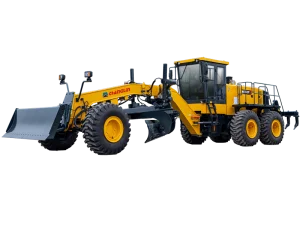
- Road Surface Construction & Maintenance: Pair motor graders like the heavy-duty PY350T or PY240H with vibratory road rollers (GYR162) to grade sub-bases and finish asphalt paths paved with efficiency.
- Waste Management & Landfills: Landfill compactors such as the GYL203 work alongside wheel loaders (ZL60H) and dozers (YD320) to maximize cell density, crush refuse, and extend landfill lifespan.
- Confined Urban & Landscaping Works: Where space prevents backhoe loader stabilization, compact skid steer loaders (255F Skid Steer) deliver unmatched 360-degree zero-radius maneuverability.
Featured Earthmoving & Heavy Machinery Series (Part II)
Complete your fleet procurement plan with our high-torque motor graders, heavy-duty mining excavators, and compact skid steers.







Frequently Asked Questions (FAQ) for Global Machinery Buyers
Comprehensive engineering and procurement answers to clarify specs, shipping terms, engine compliance, and warranty coverage.
1. What key technical parameters should I specify when looking to buy a backhoe loader machine from a manufacturer?
When issuing an RFQ to manufacturers, clearly outline: (a) Operating weight requirement (typically 7 to 10 tons); (b) Engine power and emission standard compliance (e.g., Tier 2 / Tier 3 for non-regulated markets, Stage V / Tier 4 Final for EU/North America); (c) Backhoe digging depth (standard 4.3m up to extended 5.4m telescopic dippers); (d) Transmission type (Powershift vs. Synchro-shuttle); and (e) Auxiliary hydraulic line requirements for attachments like breakers or augers.
2. How does a backhoe loader compare to purchasing a standalone wheel loader or mini excavator?
A backhoe loader combines both functions onto a single 4x4 mobile chassis, significantly lowering capital investment, insurance, transport trailer needs, and operator headcount for general contractors. However, if your jobsite requires continuous 100% excavating or loading duty cycles without repositioning, dedicated machinery like medium crawler excavators or heavy wheel loaders (ZL60H) provides higher hourly volume throughput.
3. What shipping modes are utilized for exporting heavy machinery from Chinese factories?
Heavy machinery shipping options include: (1) RoRo (Roll-on/Roll-off): Drive-on protection ideal for complete units; (2) Flat Rack Containers: Excellent for wide body excavators or dozers; (3) 40ft High Cube Containers (SKD/CKD): Compact loaders and backhoe loaders can often have wheels/booms detached at the factory to fit inside standard closed containers, dramatically reducing ocean freight costs per unit.
4. How is international after-sales warranty and spare parts support handled?
Leading Chinese exporters support international buyers through: (a) 12-month or 2,000-hour comprehensive factory warranty; (b) Fast-track DHL/FedEx air freight for critical replacement components; (c) Consignment spare parts packages shipped inside the machine container for routine maintenance filters and wear items; and (d) Digital remote technical support via CAN-bus video diagnostics and localized service dealer networks.
5. Can factories customize machines for extreme ambient temperatures or high-altitude operations?
Yes. Factory engineering teams configure heavy machinery with extreme climate packages. Cold-weather packages include engine block heaters, glow plug preheaters, synthetic arctic hydraulic fluid, and insulated cabs. Desert high-heat packages incorporate enlarged radiator cores, tropicalized hydraulic oil coolers, multi-stage cyclone dust pre-filters, and high-output air conditioning systems.