
Featured Heavy Construction Equipment Lineup
Direct factory supply of wheel skid steers, motor graders, excavators, and compactors built for heavy industrial environments.

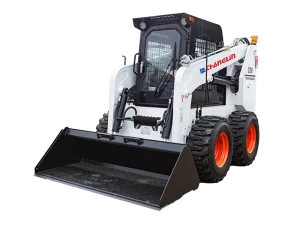






The Technological Evolution of Modern Wheel Skid Steers
From standard utility compact loaders to high-flow hydraulic robotic workhorses in global construction and mining ecosystems.
High-Flow Hydrostatics
Advanced load-sensing piston pumps delivering up to 130 L/min, enabling continuous operation of heavy cold planers, rock saws, and stump grinders without overheating.
CAN-Bus Electro-Hydraulics
Integration of proportional joystick controls, customizable operator response curves, and real-time machine telemetry for remote fleet diagnostics and predictive maintenance.
Electrification & Low Emission
Transition toward Tier 4 Final / Stage V ultra-clean diesel engines alongside high-voltage lithium battery platforms for noise-sensitive urban and underground sites.
In the modern earthmoving and material handling sector, the wheel skid steer loader has evolved far beyond its humble origins as a basic agricultural utility tool. Today, it stands as one of the most versatile, high-density power assets on job sites worldwide. Characterized by its zero-radius skid steering capability, four-wheel drive traction, and universal quick-attach coupling standard, the wheel skid steer allows contractors to deploy a single machine for dozens of specialized tasks—ranging from asphalt cold planing and trench backfilling to pallet handling and snow clearing.
The global demand for high-performance wheel skid steers is driven by urban densification, rapid infrastructure development, and a acute shortage of site labor. Contractors no longer seek single-function machinery; they require compact power units capable of operating continuous high-duty-cycle hydraulic attachments. Modern wheel skid steer factories have responded by engineering heavy-duty rigid chassis designs, integrating dual-speed hydrostatic transaxles, and upgrading cooling capacities to withstand continuous ambient temperatures exceeding 50°C in desert and tropical mining applications.
Information Gain Key Takeaway: Radial vs. Vertical Lift Dynamics
When selecting machines from a wheel skid steer manufacturer, structural lift geometry dictates application efficiency. Radial lift kinematics provide maximum reach at mid-range heights, making them optimal for digging, grading, and ground-level pushing. Conversely, vertical lift path designs maintain maximum reach at full height, increasing payload efficiency for loading high-sided tandem dump trucks and stacking heavy pallets.
Why Sourcing Wheel Skid Steers from Chinese Factories Yields Strategic ROI
Combining world-class component supply chains, automated robotic welding, and rigorous ISO quality control standards.
Integrated Industrial Supply Chain
Chinese skid steer manufacturing hubs (such as Changzhou and Jiangsu heavy equipment clusters) house a complete supply ecosystem within a 50km radius. Key hydraulic components—including Rexroth-style axial piston pumps, Danfoss orbital motors, and Poclain drive units—are seamlessly integrated with high-tensile structural steel chassis, drastically reducing lead times and bill-of-materials costs.
Precision Robotic Fabrication & QA
Leading Chinese factories utilize multi-axis ABB and Fanuc robotic welding cells to ensure 100% weld penetration consistency on high-stress loader arms and mainframes. Ultra-sonic non-destructive testing (NDT), automated hydraulic oil cleanliness verification (NAS Grade 7 or higher), and 50-hour continuous stress testing guarantee zero out-of-box defects.
Over the past decade, Chinese heavy equipment manufacturers have transformed from volume producers into global technology benchmarks. By combining international component sourcing (such as Tier-4 Final Kubota, Yanmar, or Perkins engines) with proprietary heavy-duty structural designs, Chinese OEM wheel skid steer factories offer international buyers an unprecedented ratio of reliability to total cost of acquisition.
Furthermore, Chinese manufacturers excel in modular OEM/ODM customization. Whether overseas importers require FOPS/ROPS Level II certified cabins, customized high-flow auxiliary hydraulic circuits (up to 25 MPa), specific quick-attach coupling interfaces (Bobcat or universal standard), or extreme cold-weather pre-heating systems for Nordic environments, Chinese engineering teams deliver tailored configurations without prohibiting minimum order quantities.
Engineering Solutions & Application Metrics
Quantifiable performance metrics across municipal, agricultural, mining, and port logistics deployments.
Municipal & Utilities
Asphalt milling, trench cutting for fiber optics, road repair with hydraulic breakers, and winter snow removal using V-blades and rotary blowers.
Mining & Tunnelling
Low-clearance underground cleanup under conveyor belts, rock clearing in tight adits, and hazardous material removal with remote control setups.
Agribusiness & Forestry
Handling large round bales, cleaning livestock enclosures with scrapers, brush cutting with heavy-duty mulchers, and tree spade transplanting.
Port Bulk Clearance
Operating inside ship cargo holds to scrape and consolidate raw iron ore, coal, and grain into crane bucket sweep radius during offloading operations.
Technical Specification Benchmark & Procurement Matrix
Essential technical parameters international buyers must evaluate before placing factory orders.
| Performance Parameter | Light-Duty Compact (400-700 kg ROC) | Medium Utility (700-1,000 kg ROC) | Heavy Industrial (1,000-1,400+ kg ROC) |
|---|---|---|---|
| Primary Target Applications | Landscaping, residential trenching, light farming | Municipal road works, general contracting, rental fleets | Heavy mining, asphalt cold planing, bulk hold cleaning |
| Engine Output Range | 35 HP – 50 HP (Kubota / Yanmar Stage V) | 60 HP – 75 HP (Perkins / Cummins / Xinchai) | 85 HP – 110 HP (Turbocharged Intercooled Diesel) |
| Hydraulic System Pressure & Flow | 18-20 MPa | 55-70 L/min Standard | 21-23 MPa | 75-95 L/min High-Flow Option | 24-25 MPa | 110-135 L/min Super High-Flow |
| Lift Kinematics Options | Radial Lift (Maximum mid-height reach) | Radial or Vertical Lift path configurations | Vertical Lift (Optimized truck loading efficiency) |
| Operating Weight Range | 2,100 kg – 2,800 kg | 3,000 kg – 3,600 kg | 3,800 kg – 4,500 kg |
| Container Shipping Capability | 4 Units per 40ft High Cube Container | 2-3 Units per 40ft High Cube Container | 2 Units per 40ft High Cube Container (Flat Rack optional) |
Total Cost of Ownership (TCO) Optimization for Fleet Managers
When procuring wheel skid steers in volume from manufacturer factories, smart purchasing agents calculate total life-cycle cost rather than focusing exclusively on FOB unit pricing. The critical factors influencing 5-year TCO include:
- Fuel Specific Consumption Rate: Modern direct-injection high-pressure common rail (HPCR) engines consume up to 15% less diesel per operating hour compared to older mechanical pump designs.
- Hydraulic Fluid Cooling Efficiency: Oversized aluminum plate-fin radiators prevent oil breakdown at elevated ambient temperatures, preserving valve seals and motor lifespans.
- Tire Selection & Tread Life: Heavy-duty 12-16.5 14PR foam-filled or solid flex tires eliminate costly jobsite punctures in demolition and recycling applications.
- Modular Component Accessibility: Rear-opening engine hood doors and tilt-forward cab structures allow technicians to perform 500-hour filter and fluid changes in under 40 minutes.
Export Shipping Protocols & Factory Quality Inspection
Ensuring seamless international customs clearance, transit protection, and warranty support.
Export Containerization
Professional container loading teams secure wheel skid steers using steel wire tie-downs, wheel chocks, and anti-vibration padding. Disassembled bucket and boom components are packed in customized steel frames to maximize container volume utilization.
Marine Corrosion Protection
Every machine destined for ocean transport undergoes full-body wax sealing, electrical terminal anti-moisture coating, and vacuum-wrapped hydraulic cylinder rod protection to withstand sea salt spray during 40+ day ocean transit.
International Compliance
All export models carry comprehensive documentation packages including CE Machinery Directive compliance, ROPS/FOPS cabin safety certificates, EPA/Stage V engine emissions test reports, and ISO 9001 quality factory audit certificates.
Frequently Asked Questions by Industrial Buyers
Detailed answers to crucial engineering, procurement, and operational queries regarding wheel skid steers.
What are the key mechanical differences between Radial Lift and Vertical Lift Wheel Skid Steers?
Radial lift machines move the bucket pins in an arc-like path during elevation. This configuration provides maximum forward reach at mid-height (waist level), making radial lift wheel skid steers superior for heavy ground excavation, grading, prying, and trenching applications. Vertical lift machines use dual linkage arms that extend the pins virtually straight up, providing maximum forward reach at full elevation. Vertical lift models are optimal for loading high-sided dump trucks, stacking pallets in warehouse setups, and placing materials over high wall barriers.
How does High-Flow Auxiliary Hydraulics impact attachment performance?
Standard auxiliary hydraulic systems typically deliver between 50 to 75 L/min of fluid flow at 20 MPa pressure. This is sufficient for light tools such as augers, standard buckets, and grapple forks. High-Flow hydraulic options increase oil delivery to 110-130 L/min, providing the hydraulic horsepower required for power-demanding attachments like cold planers (asphalt milling machines), high-capacity snow blowers, forestry mulchers, and heavy rock saws. Choosing High-Flow options expands the skid steer's operational capabilities across specialized contracting niches.
What custom OEM/ODM options do Chinese wheel skid steer factories support?
Chinese OEM factories offer extensive custom configurations including: engine brand selection (Kubota, Yanmar, Perkins, Cummins, or domestic Euro V engines), hydraulic system upgrades (Rexroth, Sauer-Danfoss), closed or open cab options with air conditioning/heating, customized color schemes and logo branding, attachment quick-coupler compatibility (Bobcat universal standard), heavy-duty foam-filled or solid tires, and specialized electrical interfaces for smart attachments.
How do Chinese manufacturers ensure the structural durability of loader arms?
Leading factories engineer loader arms using Q355B or high-strength Q690D alloy steel plates. Robotic welding cells execute multi-pass welds with continuous temperature monitoring to prevent thermal distortion. Critical stress points—such as cylinder pivot bosses and boom link connections—feature heavy cast steel bushings. Finite Element Analysis (FEA) computer modeling is validated through 5,000-hour real-world fatigue stress testing prior to full mass production.
What international export documentations are provided with machinery shipments?
Standard export shipments include a full commercial invoice, detailed packing list, ocean Bill of Lading (B/L), Certificate of Origin (Form E, CO, or Form F depending on trade agreements), CE Certificate of Conformity, ROPS/FOPS safety test certificates, and factory pre-delivery inspection (PDI) quality sheets. Additional third-party inspection reports from SGS, BV, or Intertek can be provided upon request.
How are spare parts and post-warranty service handled for overseas buyers?
Factories supply recommended 2-year maintenance spare parts packages (filters, hydraulic seals, wear pads, tire sets) alongside initial equipment orders. Critical spare parts are dispatched via DHL/FedEx express within 24-48 hours. Furthermore, detailed digital parts catalogs, 3D exploded assembly diagrams, and direct remote engineering video support ensure local fleet technicians can diagnose and resolve maintenance items promptly.
What is the standard manufacturing lead time for bulk container orders?
Standard model configurations typically feature a 15 to 25 calendar day manufacturing cycle from deposit confirmation. Custom OEM/ODM orders requiring specialized engines, custom hydraulic valving, or unique attachment integrations usually require 30 to 45 days. Rapid shipping arrangements via major ocean carriers ensure predictable delivery schedules to major ports across North America, Europe, Southeast Asia, South America, and Africa.
What advantages do electric wheel skid steers bring to underground & indoor jobsites?
Electric wheel skid steers powered by lithium iron phosphate (LiFePO4) battery packs eliminate 100% of local carbon monoxide and particulate emissions. This eliminates the need for expensive forced ventilation systems when operating inside tunnels, food processing plants, indoor demolition sites, and underground mines. Additionally, electric skid steers deliver instantaneous hydraulic torque response, operate at sound levels below 70 dB, and reduce energy operating costs by up to 60% compared to equivalent diesel units.
Explore Additional Industrial Equipment Lineup
Factory-direct road construction rollers, landfill compactors, motor graders, and wheel loaders.




