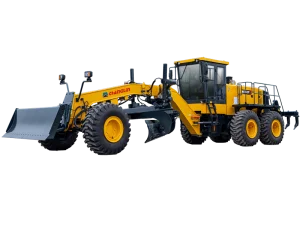
Featured Heavy Motor & Road Grader Models
Factory-direct high-precision road graders engineered for extreme tractive power, subgrade leveling accuracy, and robust heavy-duty operation.








Global Infrastructure Landscape & Road Grader Procurement Vectors
Modern civil infrastructure demand has shifted from simple earthmoving to millimeter-precision surface preparation, haul-road optimization in high-tonnage mining, and climate-resilient subgrade construction.
High-Tonnage Mine Haul Roads
In mega-mining operations across South America, Central Asia, and Africa, heavy motor graders (220HP to 350HP+) maintain ultra-wide haul paths. By keeping rolling resistance below 2.5%, these machines reduce haul-truck fuel consumption by up to 12% and cut tire wear costs by 30%.
Transcontinental Expressways
National highway expansion projects in developing economic corridors require high-speed earth spreading, slope cutting, and ditching. Heavy-duty tandem axle road graders enable multi-pass leveling with strict adherence to structural sub-base compaction criteria.
Airport & Commercial Logistics
Runway sub-grade preparation demands total planarity. Integrated electro-hydraulic 3D automatic grading systems interface seamlessly with optical total stations and dual GNSS receivers, reducing human operator error to negligible thresholds.
Kinematic & Hydraulic Architecture of Road Graders
Understanding the structural integrity, moldboard force dynamics, and load-sensing fluid dynamics that distinguish premium industrial road graders from standard earthmoving equipment.
1. Articulated Frame & Circle Drive System
The structural backbone of a high-performance road grader consists of a heavy-duty box-section frame engineered to withstand massive torsional forces. The articulation joint—positioned forward of the cab—allows frame steering angles of up to ±25 degrees. This enables crab steering, facilitating earth spreading around tight radius curves while keeping the drive tandems on solid ground.
The circle drive features a heat-treated internal gear cut with precision teeth, driven by a hydraulic motor and double-reduction worm gearbox. High wear-resistant bronze alloy wear inserts prevent metal-to-metal friction, maintaining tight tolerances over thousands of operational hours.
2. Load-Sensing Variable-Displacement Hydraulics
Modern road graders utilize a Closed-Center Load-Sensing (CCLS) hydraulic system powered by variable-displacement axial piston pumps. Unlike open-center systems that generate continuous parasitic heat and energy loss, CCLS delivers hydraulic oil flow and system pressure precisely matching the instantaneous load on the moldboard cylinders.
Proportional electro-hydraulic control valves allow simultaneous multi-function blade manipulation without speed drops across individual circuits, giving operators unparalleled control during fine grading operations.
| Spec Class | PY130H - Light Utility | PY180H - Medium Highway | PY220H - Heavy Construction | PY350T - Mining Heavyweight |
|---|---|---|---|---|
| Operating Weight | 11,500 kg | 15,500 kg | 16,500 - 17,200 kg | 28,000 kg |
| Engine Output | 97 kW (130 HP) | 132 kW (180 HP) | 162 kW (220 HP) | 257 kW (350 HP) |
| Moldboard Length | 3,660 mm (12 ft) | 3,660 mm (12 ft) | 4,270 mm (14 ft) | 4,880 mm (16 ft) |
| Transmission Type | Electro-Hydraulic PowerShift | PowerShift (6F/3R) | PowerShift w/ Lock-Up Converter | Heavy-Duty Countershaft PowerShift |
| Hydraulic System | Gear Pump / Open System | CCLS Piston Pump | Variable Displacement CCLS | Dual-Piston CCLS High Output |
| Primary Application | Municipal / Rural Roads | Highways & Base Course | Heavy Infrastructure & Earthworks | Open-Pit Mine Haul Roads |
Localized Application Scenarios & Extreme Climate Adaptations
Road graders operated in real-world conditions face vast environmental challenges. Custom engineering packages adapt basic machine platforms for regional compliance and durability.
High-Altitude & Arctic Packages
For operations in high-altitude regions (over 3,000 meters above sea level) like the Andes or Central Asian plateaus, standard engines suffer air density loss. OEM factory configurations incorporate wastegate turbocharged engines with air-to-air aftercooling, combined with electric block heaters and synthetic low-viscosity hydraulic oils rated for -40°C operation.
Desert & Tropical Dust Defense
Arid desert environments in Middle Eastern or North African mining corridors require multi-stage air filtration systems. OEM road graders deployed here feature dual-element dry air cleaners with automatic dust ejectors, sealed electrical connectors (IP67/IP69K), and high-ambient cooling packages designed to operate continuously at 55°C ambient temperatures.
Tropical Forestry & Soil Stabilization
In humid rainforest road networks, heavy clay and moisture-saturated soils demand aggressive traction. Road graders are equipped with heavy-duty rear rippers, front scarifiers, and No-Spin differential lock tandems to maximize drawbar pull while breaking up compacted organic subgrade.
OEM Manufacturing Rigor & Global Quality Assurance
Inside a world-class road grader manufacturing plant: structural robot welding, coordinate measuring machine (CMM) verification, non-destructive testing (NDT), and international safety certification.
Automated Structural Manufacturing
The strength of a road grader depends on weld integrity along the main drawbar, A-frame, and front axle assembly. Automated multi-pass robotic arc welding cells deliver deep penetration welds under ultrasonic inspection standards. Structural components undergo stress-relieving heat treatments to prevent micro-fractures during heavy blading tasks.
Machining of the circle gear table and pin joints is performed on large-scale 5-axis CNC machining centers, guaranteeing sub-millimeter axial alignment that minimizes blade chatter during fine-grading pass cycles.
International Regulatory Compliance
Exporting machinery across North America, the European Union, Southeast Asia, and Latin America requires strict adherence to regional regulatory frameworks:
- ROPS/FOPS Certification: Cab structures designed and tested to ISO 3471 (Roll-Over Protective Structure) and ISO 3449 (Falling Object Protective Structure) standards.
- Emissions Standards: Configurable engine options satisfying Tier 3, Tier 4 Final, and EU Stage V emission benchmarks.
- CE & ISO Compliance: ISO 9001 quality management, ISO 14001 environmental management, and CE safety marking for global customs clearance.
Total Cost of Ownership (TCO) & OEM Selection Strategy
Procurement teams must look beyond upfront CAPEX. Analyzing long-term fuel efficiency, wear component availability, maintenance accessibility, and residual asset value drives profitability.
CAPEX vs OPEX Optimization
Acquiring factory-direct machinery reduces initial CAPEX by 20% to 35% compared to premium Western brands without sacrificing structural reliability. When coupled with lower consumable wear-part pricing (moldboard cutting edges, end bits, circle wear strips), long-term OPEX per operating hour drops significantly.
Fuel Consumption Dynamics
Fuel represents up to 40% of total lifetime machine operational expenditure. Modern road graders equipped with variable-power curve technology dynamically adjust engine torque depending on ground speed and hydraulic load, saving up to 8% to 15% in fuel consumption per shifted cubic meter of dirt.
Maintenance & Spare Parts Logistics
Centralized service access points—ground-level grease banks, spin-on hydraulic filters, and swing-out radiator cooling packages—minimize routine daily inspection times. Standardized global component sourcing (Cummins, ZF, Danfoss systems) ensures rapid global spare parts availability.
The Next Horizon: Telematics, 3D Automation & Electrification
How next-generation motor graders are transforming from manual hydraulic machines into intelligent, connected mobile robotics platforms.
Full-Auto 3D GPS Grade Control Integration
The integration of factory-ready CAN-bus interfaces for Leica, Trimble, and Topcon 3D grade control systems allows direct control over the moldboard cylinders. The operator simply steers the machine while the system automatically adjusts blade height, cross-slope, and pitch to match BIM/CAD site models within 5mm accuracy tolerances.
Hybrid & Battery-Electric Powertrains
Zero-emission job sites and underground mining operations are accelerating the development of battery-electric motor graders (e-Graders). High-voltage lithium iron phosphate (LFP) battery packs coupled with dual electric motors offer instant hydraulic response, eliminated engine idling emissions, and up to 70% reduction in total powertrain maintenance costs.
Frequently Asked Questions for Equipment Buyers & Fleet Managers
In-depth technical answers regarding road grader selection, factory customization, maintenance, and international procurement processes.
Explore Allied Construction & Mining Machinery
Discover our comprehensive fleet portfolio including mining motor graders, landfill compactors, crawler excavators, heavy wheel loaders, and road rollers.