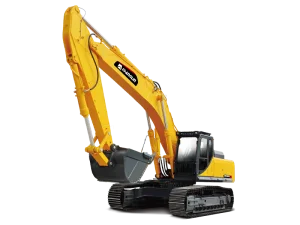
Heavy Construction Equipment & Excavators (Part I)
Factory-direct crawler excavators, motor graders, and wheel loaders engineered for extreme operational environments across 180+ countries.







1. Global Industrial & Commercial Landscape of Hydraulic Excavators
An authoritative evaluation of macro-economic drivers, fleet demand shifts, and technology penetration across global earthmoving sectors.
The global market for hydraulic excavators is undergoing a structural transformation. Driven by large-scale infrastructure investments in emerging economies, mining expansion in South America and Central Asia, and urbanization initiatives across Africa and Southeast Asia, demand for reliable, high-efficiency earthmoving machinery has reached unprecedented levels. Modern contractors no longer evaluate excavators solely based on nominal engine horsepower or bucket breakout force; the focus has decisively pivoted toward Total Cost of Ownership (TCO), hydraulic system responsiveness, fuel efficiency per ton of excavated material, and telemetry integration.
Hydraulic excavators represent the foundational cornerstone of modern heavy civil engineering, earthmoving, quarrying, and demolition operations. As global emission mandates transition toward EU Stage V and US Tier 4 Final standards, premier manufacturers are redesigning hydraulic circuit architectures—shifting from traditional open-center hydraulic systems to negative-flow and high-efficiency positive-flow hydraulic systems managed by electronic main control valves (MCV).
Heavy Civil Infrastructure
Mass excavation, highway construction, bridge foundations, and deep trenching require medium-to-large crawler excavators (20t to 40t class) capable of continuous multi-shift operation with minimal hydraulic thermal breakdown.
Mining & Hard Rock Quarrying
Heavy-duty mining excavators (45t to 90t+) demand reinforced boom structures, cast steel linkage points, forged bucket teeth, and heavy-duty undercarriages capable of handling abrasive granite, iron ore, and overburden removal.
Urban Utility & Municipal Works
Compact and mini excavators featuring short tail-swing radius, auxiliary hydraulic lines for breakers/augers, and rubber track pads dominate residential landscaping, pipe laying, and congested city road maintenance.
2. Why Source from Chinese Machinery Manufacturers & OEM Factories?
Decoupling the industrial advantages of China's Changzhou heavy machinery manufacturing base: Cluster integration, quality control, and cost velocity.
Complete Integrated Supply Chain Synergy
China's Yangtze River Delta industrial hub—specifically the Changzhou and Jiangsu manufacturing zones—houses the world's most dense ecosystem for heavy machinery component sourcing. From high-tensile structural steel plates (Q355D, Q690D) to precision-machined slewing rings, forged track rollers, and hydraulic cylinders, 95% of sub-components are manufactured within a 50-kilometer radius. This eliminates logistics bottlenecks, drastically shortens OEM lead times, and allows factory-direct customization without exorbitant price premiums.
Global Top-Tier Component Integration
Leading Chinese heavy machinery OEMs like Sinomach-HI (Changlin base) adopt a hybrid engineering approach. We pair world-class, battle-tested core powertrain and hydraulic components with ultra-efficient local structural manufacturing:
- Engine Systems: Tier-3 and Stage-V compliant Cummins, Isuzu, and Weichai turbo-charged diesel engines engineered for high torque at low operating RPM.
- Hydraulic Architecture: Primary variable displacement axial piston pumps and main control valves engineered by Kawasaki-KPM, Rexroth, or Parker.
- Drive & Transmission: Nabtesco or Doosan slewing motors and final drive travel reduction gearboxes engineered for high tractive force.
Manufacturing Quality Metrics (Sinomach-HI OEM Standards)
Our Changzhou manufacturing facility operates under strict ISO 9001, ISO 14001, and ISO 45001 certifications, enforcing 100% full-cycle non-destructive testing (NDT) on structural welds.
3. Advanced Hydraulic Engineering & Micro-Architecture
Understanding the fluid power mechanics that dictate digging forces, hydraulic cycle times, and fuel savings in modern excavators.
The efficiency of a hydraulic excavator is primarily governed by the interaction between its engine power curve and main hydraulic pump delivery. Traditional open-center hydraulic systems suffer from constant hydraulic fluid throttling losses across control valve spools. Next-generation Chinese excavators utilize Load-Sensing Hydraulic Systems (LSS) and Negative Flow / Positive Flow Electronic Control Systems to eliminate wasted hydraulic horsepower.
Positive-Flow Hydraulic Control (PFHC)
In a positive-flow hydraulic system, electronic sensors measure pilot joystick displacement and directly command the variable displacement pump to deliver the exact required hydraulic oil volume. Unlike negative control systems that read return pressure signals, positive control provides instantaneous hydraulic response, eliminates operator lag, and reduces fuel consumption during complex compound movements (such as simultaneous boom lifting, arm crowding, and swing bucket dump) by up to 12%.
Hydraulic Arm & Boom Regeneration Circuits
During arm dumping or boom lowering operations, kinetic and gravitational forces force hydraulic oil back out of the cylinders. Integrated hydraulic regeneration valves recycle this pressurized oil back into the opposing cylinder chamber without drawing energy from the main hydraulic pump. This speeds up digging cycle times by 8-15% while keeping hydraulic oil temperatures lower, dramatically extending seal and oil life.
4. Localized Global Application Scenarios & Job-Site Configurations
How custom-configured hydraulic excavators perform under extreme climate, altitude, and geological conditions.
High-Altitude Mining (Andes / Central Asia)
Operations above 3,000 meters suffer from air density drops, reducing engine oxygen mass. Custom high-altitude configurations feature wastegate turbochargers, enlarged hydraulic radiator fan blades, and recalibrated ECU fuel maps to prevent power derating and maintain full hydraulic pressure.
Tropical Extreme Dust & Heat (Middle East / Africa)
Operating in ambient temperatures exceeding 50°C requires heavy-duty dual-element air pre-cleaners (Donaldson type), independent electric fan hydraulic cooling systems, and specialized high-viscosity hydraulic fluids (ISO VG 68) to protect pump plates against cavitation.
Sub-Zero Arctic Environments (CIS / Northern Europe)
Temperatures down to -40°C compromise steel ductility and hydraulic seal elasticity. Arctic packages integrate engine coolant pre-heaters (Webasto), low-temperature synthetic hydraulic fluids, steel structures crafted from cold-impact-resistant alloy plates, and cab thermal insulation.
5. Global Fleet Procurement Guide & TCO Optimization
A structured evaluation matrix for procurement managers, mining operators, machinery dealers, and EPC contractors.
When procuring heavy earthmoving machinery internationally, evaluating the purchase price (CapEx) alone accounts for less than 25% of the machine's total 5-year lifecycle cost. Smart procurement teams assess fuel consumption efficiency, maintenance interval windows, parts replacement availability, and final shipping logistics.
CapEx vs. OpEx Breakdown
Chinese OEM excavators from tier-1 manufacturers offer 30% to 45% initial CapEx savings compared to equivalent Japanese or European branded machines. When combined with standardized consumable parts (filters, seal kits, track shoes) and lower replacement component pricing, the 10,000-hour TCO is reduced by approximately 22% per ton of earth moved.
Incoterms & International Shipping Logistics
Navigating global freight requires flexible equipment breakdown and packing options:
- Flat-Rack Containers (FR): Ideal for 20t to 35t excavators by removing the arm/boom or counterweight to fit standard ocean freight frames.
- Roll-on/Roll-off (RoRo): Preferred for heavy mining excavators (40t+) allowing fully assembled units to drive directly onto specialized carrier vessels.
- SKD / CKD Containerized Shipping: Compact excavators can be packed in 40ft High Cube (HQ) containers to maximize shipping density.
6. Excavator Engineering Specifications Comparison
Technical comparison matrix across core factory-direct crawler excavator models.
| Model Class | Operating Weight | Rated Power | Bucket Capacity | Hydraulic Main Flow | Max Digging Depth |
|---|---|---|---|---|---|
| ZG150 (Compact/Medium) | 14,300 kg | 85 kW @ 2200 rpm | 0.60 m³ | 2 x 126 L/min | 5,530 mm |
| ZG250 (Medium General) | 24,500 kg | 133 kW @ 2000 rpm | 1.20 m³ | 2 x 234 L/min | 6,920 mm |
| ZG330D (Heavy Infrastructure) | 33,100 kg | 212 kW @ 2000 rpm | 1.60 m³ | 2 x 290 L/min | 7,380 mm |
| ZG385 (Heavy Excavation) | 37,800 kg | 228 kW @ 1900 rpm | 1.90 m³ | 2 x 320 L/min | 7,520 mm |
| ZG480 (Heavy Mining) | 47,500 kg | 299 kW @ 1800 rpm | 2.40 m³ | 2 x 380 L/min | 7,810 mm |
7. Technological Trends Shaping the Next-Gen Excavator Industry
Electrification, 5G Tele-Operation, and Autonomous Machine Guidance (2025–2035).
Electrification & BEV Technology
Battery Electric Excavators (BEVs) equipped with high-voltage Lithium Iron Phosphate (LFP) battery packs are surging in urban sites, tunnels, and port facilities. Zero local carbon emissions, zero acoustic noise pollution, and up to 60% savings in energy costs make BEVs the primary growth segment.
3D GPS Machine Guidance & Telemetry
Integrating 3D GNSS grade control systems directly into main control valves allows real-time automated bucket depth placement within 1-centimeter accuracy tolerances. Telemetry platforms broadcast real-time hydraulic oil temperature, engine load factor, and fault codes to central fleet operations.
5G Remote & Autonomous Operation
In hazardous mining environments or dangerous slope excavations, ultra-low latency 5G tele-operation kits allow operators to control heavy excavators safely from comfortable remote control stations miles away, dramatically enhancing job-site safety.
8. Frequently Asked Questions by Global Buyers
Clear, authoritative answers regarding OEM factory sourcing, custom modifications, logistics, and technical support.
Heavy Earthmoving & Road Equipment Lineup (Part II)
Explore our full line of crawler excavators, heavy landfill compactors, vibratory road rollers, and mining dozers.