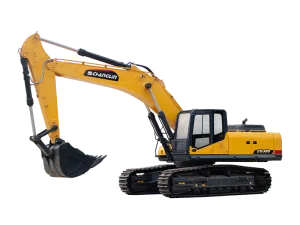
Heavy Engineering & Machinery Fleet Portfolio
Factory-direct earthmoving, compaction, and material handling solutions engineered for rigorous high-load duty cycles.








The Engineering Blueprint of Large Excavator Manufacturing
Analyzing structural metallurgy, high-pressure electro-hydraulic integration, and fleet productivity economics in heavy civil works and extraction mining.
Structural Metallurgy & Stress Analysis
Ultra-large hydraulic excavators operating within the 30-ton to 100-ton+ spectrum require sophisticated structural engineering. High-tensile steel alloys, stress-relieved boom weldments, and heavy-duty X-frame undercarriages ensure long fatigue life under severe torsional loading conditions typical of granite quarrying and mine stripping operations.
Electro-Hydraulic Management
Modern heavy excavators utilize positive-flow control (PFC) hydraulics, matching main pump displacement directly with spool motion vectors. This reduces internal fluid friction losses by up to 18%, maximizing hydraulic horsepower delivered to the bucket edge while reducing overall diesel consumption per bank cubic meter (BCM) moved.
Total Life-Cycle Productivity
When global EPC contractors evaluate capital expenditure (CAPEX) for heavy machinery, structural service life and component mean time between failures (MTBF) outweigh initial purchase pricing. Leading Chinese manufacturing clusters have redefined TCO ratios by offering world-class reliability at optimized procurement entry points.
Why Top Global Fleet Operators Source Large Excavators from China
China's heavy industrial manufacturing hubs deliver unmatched integration speed, robust supply chains, and cutting-edge automation in heavy excavator fabrication.
The global heavy machinery sector has undergone a structural paradigm shift over the past decade. China's top tier manufacturing plants—such as those operating in Changzhou and Jiangsu industrial corridors—have evolved from regional fabricators into world-leading research, development, and manufacturing centers for heavy earthmoving machinery. By leveraging state-of-the-art robotic welding cells, fully automated ultrasonic flaw detection systems, and clean-room hydraulic assembly environments, Chinese factories achieve structural integrity metrics that match or exceed traditional European and Japanese standards.
Furthermore, the strategic integration of tier-one international powertrain and hydraulic components—such as low-emission Cummins and Weichai engines, combined with Kawasaki and Rexroth main pumps and valve blocks—guarantees that heavy excavators produced in China offer seamless operational familiarity, rapid global spare parts availability, and effortless field repairability for global mine operators.
Large Excavator Engineering Matrix & Operational Specs
Comparative technical breakdown across key tonnage classes manufactured for heavy civil infrastructure, open-pit mining, and quarry mass excavation.
| Operating Weight Class | Target Applications | Engine Power Output | Hydraulic System Configuration | Primary Bucket Capacity Range |
|---|---|---|---|---|
| 21T - 25T Medium-Large (e.g., ZG210, ZG220) |
Heavy urban infrastructure, trenching, bulk earthworks, road construction. | 115 kW - 133 kW (Cummins / Weichai Diesel) |
Dual variable displacement axial piston pumps, positive flow control. | 0.9 m³ - 1.2 m³ Heavy-Duty Rock Bucket |
| 33T - 38T Heavy Heavy-Duty (e.g., ZG330D, ZG360, ZG380) |
Quarry overburden, deep foundation excavation, heavy civil works. | 198 kW - 212 kW (Turbocharged Intercooled) |
Electro-hydraulic load-sensing system with power-boost functionality. | 1.6 m³ - 1.9 m³ Reinforced Quarry Bucket |
| 50T - 100T Mining Class (Ultra-Large Fleet Units) |
Open-pit mining extraction, blasted rock loading, heavy slag removal. | 280 kW - 400+ kW (Tier 3 / Stage V Compliant) |
Multi-circuit independent hydraulic architecture with oil-cooler bypass. | 2.5 m³ - 6.0+ m³ Extreme Duty Armored Bucket |
Technological Advancement Trends in Heavy Excavator Manufacturing
Exploring the strategic technological vectors transforming the heavy equipment industry from 2025 through 2030.
1. Electrification & Hybrid Powertrains
Driven by stringent ESG compliance metrics and rising diesel overheads, zero-emission electric wheel loaders (such as the ZL50EV) and cable-tethered electric mining excavators are gaining dominant traction in indoor crushing stations, tunnel projects, and zero-carbon ports.
2. 5G Tele-Operation & Autonomous Digging
Ultra-low latency 5G remote control systems enable operators to handle excavators located in high-risk environments—such as unstable rock faces, hazardous waste landfills, and extreme temperature zones—from the comfort and safety of an off-site control tower.
3. Predictive IoT Diagnostics & Telematics
Integrated CAN-bus sensors monitor hydraulic oil contamination, pump delivery pressure spikes, and engine thermal gradients in real time. Machine-learning algorithms predict component failure prior to unscheduled downtime, protecting fleet revenue streams.
Macro-Industry Solutions & Severe Environment Customization
Engineering heavy machines specifically configured for extreme thermal ranges, high altitude, and high-abrasion operating environments.
High-Altitude Alpine Customization
At elevations exceeding 3,000 meters above sea level, thin air causes severe diesel engine power derating and cooling degradation. China's top excavator factories integrate forced turbo-charging power matching, oversized aluminum radiator cores, and low-viscosity hydraulic fluids to ensure nominal productivity in high-altitude Andean or Himalayan mining sites.
Sub-Zero Extreme Cold Packages
For operation in northern CIS and Arctic climates reaching -30°C, heavy excavators are fitted with engine block pre-heaters, fuel line heating circuits, Arctic-grade steel plates that prevent low-temperature brittle fractures, and double-glazed heated operator cabins.
High-Temperature Thermal & Dust Defense
Operating in desert mining environments requires heavy-duty multi-stage cyclone air pre-cleaners to prevent silica dust ingress into the engine combustion chamber, alongside independent hydraulic oil cooling fans with automatic reverse-blowing dust purging capabilities.
Global Procurement, Quality Assurance & Shipping Logistics
A comprehensive guide for international purchasing directors, equipment distributors, and project managers sourcing Chinese heavy machinery.
Factory Audit & Inspection Protocols
Prior to contract finalization, international enterprise buyers conduct rigorous factory audits covering ISO9001 quality management compliance, structural weld non-destructive testing (NDT), and continuous 8-hour hydraulic system hot-run testing. Independent third-party inspection firms such as SGS, Bureau Veritas, or TÜV are routinely accommodated on Chinese factory assembly lines.
Heavy Equipment Maritime Shipping
Navigating maritime logistics for heavy excavators requires meticulous planning. While compact units like skid steers can be containerized, 20T to 40T crawler excavators are transported via specialized Roll-on/Roll-off (Ro-Ro) vessels or secured onto heavy-duty Flat Rack containers with corrosion-inhibiting marine wax coating.
Aftermarket Support & Spare Parts Consignment
To minimize operational downtime in remote mining concessions, major factories establish localized spare parts distribution centers and offer fast-moving wear parts consignment packages (bucket teeth, hydraulic seal kits, filters, track shoes) shipped concurrently with the machinery fleet.
Frequently Asked Questions for Overseas Equipment Buyers
Addressing critical technical, logistics, and operational queries from global procurement officers.
Q1: How do Chinese-manufactured heavy excavators compare in hydraulic reliability against Japanese or European OEM brands?
Modern Chinese excavators produced by premier state-level manufacturing facilities utilize identical core tier-one global hydraulic components (such as Kawasaki hydraulic pumps and main control valves, Rexroth pilot controls, and Parker seal kits) combined with advanced localized structural engineering. This results in hydraulic pressure stability and operational smoothness matching top Western brands, while providing significant cost savings in procurement and replacement parts.
Q2: What is the optimal bucket-to-tonnage ratio for mining overburden versus heavy infrastructure trenching?
For heavy infrastructure and earthmoving, a 21-ton to 25-ton excavator (e.g., ZG210D/ZG220) typically operates a 1.0 m³ to 1.2 m³ standard bucket optimized for speed and cycle efficiency. In contrast, for dense quarry rock and mining overburden, a 36-ton to 38-ton excavator (e.g., ZG360/ZG380) employs a heavy-duty reinforced 1.6 m³ to 1.9 m³ rock bucket with high-abrasion tooth adapters, shorter lip profile, and side wear plates to handle high breakout forces.
Q3: What export compliance documents and quality certifications are required for importing large excavators into North America, EU, and Latin America?
Depending on the target jurisdiction, heavy excavators require engine emissions compliance (EPA Tier 4 Final for North America, Stage V for the European Union, or Tier 3 / Stage III for Latin America and Africa). Equipment documentation must include CE certification, ISO 9001 quality certificates, Certificate of Origin (Form E, Form A, or RCEP for duty preferences), Commercial Invoice, Packing List, and Bill of Lading.
Q4: How are spare parts and structural warranty issues handled for international mine sites in remote locations?
Leading Chinese equipment suppliers establish worldwide dealer service networks (covering over 300 dealers and 650 service sites globally). For large fleet purchases, manufacturers supply custom containerized "First-Line Maintenance Kits", provide remote 5G tele-diagnostic assistance, and dispatch field service engineers directly to mine sites for warranty overhauls.
Q5: Can heavy excavators be customized for high-altitude (3,000m+) or extreme temperature (-30°C to +50°C) environments?
Yes. Factories customize machine specs based on jobsite GPS coordinates and weather profiles. Custom options include engine turbocharger pressure recalibration for high altitude, low-temperature synthetic hydraulic oils, Arctic battery heaters, thermal insulation jackets, and heavy-duty radiator dust screens.
Q6: What is the estimated ROI timeline for switching from conventional diesel loaders/excavators to electric or dual-power heavy units?
For operations with accessible grid power or site energy storage systems (such as aggregate crushing plants, ports, and indoor processing facilities), electric heavy machinery like the ZL50EV wheel loader reduces energy expense by up to 60-70% compared to diesel equivalents. The typical payback period for the initial capital price premium is realized within 12 to 18 operating months depending on localized diesel electricity spread.
Explore Complete Earthmoving & Road Construction Machinery
Factory-direct specialized machinery: Motor graders, bulldozers, skid steers, wheel loaders, and road compactors.