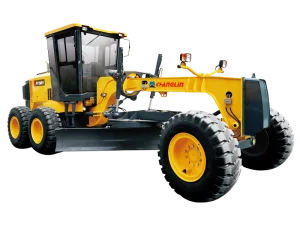
Featured Earthmoving & Construction Fleet Equipment
Direct-from-factory heavy equipment integrated with precision structural counterweight configurations for international project tenders.








Macro-Industry Solutions: Physics of Backhoe Loader Operating Weight
Understanding the critical balance between chassis weight distribution, hydraulic breakout forces, and dynamic stability across diverse global job sites.
Kinematic Mass Distribution
The total operating weight of a backhoe loader (typically ranging from 6,500 kg to 10,500 kg in Chinese OEM manufacturing centers) directly dictates its static tipping load and digging stability. Proper weight allocation between the heavy-duty cast front axle and the planetary rear drive axle prevents tipping during high-reach bucket loading and maximum-depth trenching.
Hydraulic Breakout vs. Structural Weight
Higher hydraulic pressures require a proportionate structural steel frame mass to absorb torsional strain. Leading Chinese factories utilize High-Strength Low-Alloy (HSLA) Q460 steel frames. Without sufficient counterweight ballast, high breakout forces (exceeding 60 kN) simply lift the chassis off the ground rather than penetrating compacted subsoil or blasted rock.
Transportation & Axle Load Limits
Global civil engineering contractors must balance machine weight against local road transport regulations. Operating weights under 8,000 kg allow flatbed transit without special oversized permits in South America, Africa, and Southeast Asia, while heavier 10-ton variants offer superior lifting capacities for heavy pipe-laying and quarry support operations.
OEM Engineering Information Gain: The Center of Gravity (CoG) Factor
In side-shift backhoe loaders manufactured in China, the side-shift carriage adds up to 650 kg of dynamic cantilevered weight to the rear structure. Chinese OEM factories engineer modular counterweight configurations (adding 150 kg to 450 kg to the front bumper) to re-establish a low center of gravity when swinging the hoe boom 90 degrees under heavy hydraulic payload conditions.
| Backhoe Loader Mass Class | Operating Weight Range (kg) | Front Axle Load (Dynamic) | Rear Axle Load (Dynamic) | Recommended Application Scenario |
|---|---|---|---|---|
| Compact Utility Class | 5,500 - 6,800 kg | 3,200 kg | 5,400 kg | Urban municipal repair, light landscaping, tight residential trenching |
| Standard Infrastructure Class | 7,600 - 8,500 kg | 4,500 kg | 7,800 kg | General civil construction, road building, agricultural ditch clearing |
| Heavy-Duty Mining Support | 8,800 - 9,800 kg | 5,200 kg | 9,100 kg | Quarry utility handling, heavy pipe laying, hard rock digging |
| Extreme Weight OEM Customized | 10,000 - 11,200 kg | 6,000 kg | 10,500 kg | High-altitude mining, heavy breaker attachment operations |
Global Commercial & Industrial Status of Chinese OEM Factories
How China's heavy equipment ecosystem has transformed global supply chains through advanced metallurgy, standardized component integration, and cost-per-kilogram efficiency.
Scale and Manufacturing Clusters
China's heavy machinery production facilities in Jiangsu and Shandong provinces leverage integrated supply chain ecosystems. From automated robotic arc-welding lines for chassis frames to direct access to high-grade structural iron foundries, Chinese factories manufacture over 35% of the world's backhoe loader structural mass assemblies, supplying both direct brands and international OEM contract partners.
Tier-1 Powertrain & Hydraulic Integration
Modern Chinese backhoe loaders are engineered around globally recognized powertrain standards. Factories seamlessly incorporate Cummins, Perkins, Weichai, and Yuchai diesel engines paired with Carraro or ZF torque converter transmissions. This allows the overall operational weight to translate directly into maximum tractive effort (rimpull) without powertrain mismatch or excessive fuel burn.
Cost-per-Tonnage Structural Value
Procurement teams from Latin America, the Middle East, Eurasia, and Africa leverage Chinese backhoe loader manufacturers to lower Total Cost of Ownership (TCO). By offering equivalent structural mass, heavy-duty loader arms, and cast counterweights at a 25-40% lower capital cost than Western OEMs, Chinese factories enable fleet managers to expand unit counts within fixed capital budgets.
Localized Application Scenarios & Weight Class Optimization
Matching specific operational ground conditions, soil friction coefficients, and hydraulic attachments to the correct machine weight class.
Urban Municipal Utilities (6.5t - 7.5t)
Work Site Challenge: Asphalt pavement preservation, narrow city lanes, underground cable trenching.
Weight Strategy: Compact weight footprint minimizes ground pressure to protect existing road sub-bases. Outrigger stabilizer pads are equipped with vulcanized rubber street pads to prevent gouging city streets during jackhammer or digging cycles.
Agricultural & Irrigation Projects (7.8t - 8.5t)
Work Site Challenge: Muddy terrain, unpaved farmland ditches, plantation road maintenance.
Weight Strategy: Four-wheel-drive (4WD) configurations combined with heavy rear wheel ballast weights (150 kg per wheel) optimize tire traction in soft clay, preventing wheel-spin while maintaining high drawbar pull for box scraping.
Mining Quarry & Rock Operations (9.0t - 10.5t)
Work Site Challenge: High-impact rock loading, heavy hydraulic breaker operations, continuous duty cycles.
Weight Strategy: Maximum machine structural mass provides dynamic damping against high-frequency hydraulic hammer vibrations. Reinforced box-section loader booms absorb torsional loads during heavy rock bucket breaking.
Structural Compliance, Safety Standards & ROPS/FOPS Load Rigor
How operating weight directly influences safety certifications, braking energy absorption, and rollover structural integrity.
ISO 3471 (ROPS) Structural Energy Absorption
Rollover Protective Structures (ROPS) must be physically tested based on the maximum gross operating weight of the machine. Chinese export factories submit cab frames to rigorous destruction testing, ensuring that under maximum loaded vehicle weight, the cab structure deforms predictably to absorb impact energy while maintaining a critical operator deflection limit volume (DLV).
ISO 3450 Braking Performance Dynamics
As operating weight increases, kinetic energy during road transit (up to 40 km/h) scales exponentially ($E_k = \frac{1}{2}mv^2$). Leading Chinese manufacturers equip 8+ ton backhoe loaders with oil-immersed multi-disc hydraulic service brakes across the rear axles, calibrated to stop fully loaded machines within strict ISO 3450 distance thresholds even on 25% slopes.
Global Homologation (CE, EAC, EPA/OSHA)
Chinese OEM export factories provide comprehensive homologation documentation. Machines destined for the EU carry CE compliance with Stage V engine configurations and noise control ratings, while units exported to North America meet EPA Tier 4 Final standards with reinforced weight-certified FOPS Level II roof guards for overhead object protection.
Technology Roadmap: The Future of Backhoe Loader Mass & Powertrain
How electrification, composite counterweights, and telematics load-sensing are redefining backhoe loader weight dynamics over the next decade.
Electrification & Battery Mass Shift
The transition to lithium iron phosphate (LiFePO4) battery packs changes traditional backhoe weight distribution. Replacing the diesel engine and fuel tank with a 120 kWh battery pack adds approximately 450 kg to the chassis center. Chinese factories leverage this structural battery mass as built-in low-profile ballast, eliminating the need for extra cast-iron counterweights while lowering the vehicle CoG by 15%.
Telematics & Dynamic Payload Sensing
Next-generation Chinese backhoe loaders incorporate pressure transducer sensors within the loader lift cylinders and backhoe boom hydraulics. Real-time onboard telematics calculate net payload mass against static tipping limits, warning operators via in-cab display screens before dynamic weight shifts cause destabilization on slopes.
High-Strength Composite Structural Arms
By implementing topology optimization software, OEM engineering departments in China are designing curved backhoe booms with variable thickness steel plating. Shaving unneeded deadweight from the working implement allows factories to shift structural mass lower into the chassis frame, increasing maximum bucket breakout force without increasing gross vehicle transport weight.
Technical Procurement Q&A: Backhoe Loader Weight Specifications
In-depth answers to critical engineering, manufacturing, and shipping questions for international heavy equipment buyers.
What is the standard operating weight range for China-manufactured backhoe loaders?
How does backhoe loader weight impact digging depth and breakout force?
Can Chinese OEM factories customize counterweight mass for specific attachments?
How are high-weight backhoe loaders packaged and shipped from China?
What steel grades are used in Chinese factories to resist heavy structural loading?
Additional Heavy Construction Machinery Catalog
Explore our complete range of high-performance road rollers, motor graders, bulldozers, and crawler excavators built for global export.