
Core Heavy Equipment Offerings
Factory-direct crawler excavators, motor graders, and skid steer loaders engineered for rugged infrastructure and mining operations.







1. The Macro Industrial Landscape of Global Builders Machinery
The global heavy construction equipment and builders machinery market is currently experiencing a structural realignment driven by large-scale infrastructure investments, aggressive open-pit mining expansion, rapid urbanization across the Global South, and stringent carbon-reduction mandates. As multi-billion dollar transportation corridors, hydrological engineering networks, and renewable energy grids are commissioned worldwide, international EPC (Engineering, Procurement, and Construction) contractors, mining conglomerates, and equipment rental providers face an unprecedented operational dilemma: balancing upfront capital expenditure (CapEx) with operational reliability and long-term fleet uptime.
Historically, tier-one equipment procurement was dominated by legacy Western and Japanese OEMs (Original Equipment Manufacturers). However, escalating machine acquisition costs, protracted component delivery cycles, and rigid pricing structures have driven asset managers to seek alternative single-source direct factory partnerships. This pivot has placed **China Builders Machinery Factories** at the epicenter of global equipment sourcing strategies. China’s heavy machinery sector has evolved beyond basic assembly into an advanced industrial ecosystem characterized by automated robotic welding, digital twin component validation, and integrated hydraulic supply chains.
Manufacturers situated in industrial strongholds such as Changzhou, Jiangsu—most notably legacy clusters like Sinomach-HI (Changlin)—represent this industrial transition. By establishing direct OEM channels, these factories offer high-duty-cycle earthmoving equipment, precision motor graders, and material handlers that match global quality standards while delivering unprecedented financial efficiency for enterprise fleet buyers.
2. Competitive Dynamics of Modern Chinese OEM Manufacturing
How localized supply chain density, automated assembly, and stringent QA testing yield quantifiable advantages for international procurement teams.
30-40% CapEx Optimization
Direct factory sourcing eliminates multi-tiered intermediary markup, enabling fleet operators to deploy broader machine capacity within existing capital budgets.
Accelerated Production Cycles
Integrated component clusters within 50 km of primary assembly facilities reduce lead times from order placement to port delivery down to 30-45 days.
Custom Job-Site Engineering
Modular production lines allow direct factory integration of high-ambient cooling packages, arctic pre-heaters, and specialized hydraulic attachments prior to shipping.
Sourcing Matrix: Legacy Western OEMs vs. Top-Tier China Builders Machinery Factory
| Evaluation Parameter | Legacy Western / Japanese OEMs | Top-Tier China OEM Direct (Sinomach-HI Platform) |
|---|---|---|
| Initial Capital Expenditure (CapEx) | High baseline price due to brand premium & global overhead | Optimized factory-direct pricing (30–40% financial gain) |
| Core Hydraulics & Powertrain | Proprietary closed-loop systems (dealer-restricted repair) | World-class components (Kawasaki, Cummins, Rexroth, ZF) |
| Spare Parts Lead Time | 4–8 weeks for non-standard wear parts | 7–14 days global dispatch via 300+ dealer network hubs |
| Customization & Attachment Prep | Rigid factory packages; aftermarket modifications void warranty | Flexible factory-installed options tailored to target site conditions |
| Telematics & Fleet Management | Subscription-locked proprietary software | Open-architecture telematics with real-time health metrics |
3. Category Breakdown & Heavy Machinery System Architecture
Exploring the mechanical, hydraulic, and structural design standards behind modern earthmoving, grading, and compaction machinery.
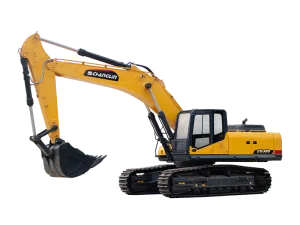
A. Heavy & Medium Crawler Excavators (ZG Series)
Crawler excavators serve as the workhorse for bulk earthmoving, heavy trenching, and quarry loading. Models like the ZG380 (38-ton class), ZG385, and ZG220 (22-ton class) utilize high-pressure electro-hydraulic proportional control systems. These units combine negative flow control with main pumps (such as Kawasaki hydraulic assemblies) to ensure exact fluid distribution to boom, stick, and bucket circuits.
- Structural Integrity: Reinforced X-chassis frames manufactured with high-tensile alloy steel to withstand continuous torsional stress in harsh quarry environments.
- Hydraulic Efficiency: Dual-pump main hydraulic circuits automatically sum flow during heavy digging passes, maximizing breakout force while reducing specific fuel consumption.
- Haul Truck Matching: Designed to load standard 20–40 ton dump trucks in 3 to 5 fluid passes, optimizing cycle times and site logistics.
B. Precision & Mining Motor Graders (PY Series)
Road formation, ditching, bank sloping, and mine haul-road maintenance demand uncompromising blade accuracy and traction. Motor graders such as the PY220H(2), PY240H, PY180H, and heavy-duty PY320T represent advanced kinematic moldboard engineering.
- Moldboard Kinematics: Direct-acting hydraulic cylinders provide full 360-degree blade rotation, bank-cutting angles up to 90 degrees, and precise pitch adjustment for varying soil densities.
- Powertrain Dynamics: Electro-hydraulic power shift transmissions paired with No-Spin differential lock axles guarantee maximum traction under heavy blading resistance without wheel slip.
- Mining Grade Heavy Frames: Models like the PY320T incorporate extra-heavy A-frame drawbars and sealed slewing rings to eliminate blade chatter on corrugated haul roads.
C. Soil Compaction & Refuse Management (GYS & GYL Series)
Achieving specified Proctor density in sub-base layers or maximizing air-space recovery in municipal landfills requires tailored compaction technology. Models such as the GYS142, GYS20J, GYS12J vibratory road rollers, and the specialized GYL233 landfill compactor embody these principles.
- Dual Frequency & Amplitude: Vibratory rollers allow operators to switch between deep soil compaction (high amplitude/low frequency) and thin asphalt surface finishing (low amplitude/high frequency).
- Landfill Refuse Crushing: The GYL233 features heavy-duty steel cleats with wear-resistant alloy caps, high static linear load, and inter-cleat scrapers to prevent material accumulation.
D. Material Handlers & Compact Utilities (ZL & TS Series)
From high-capacity wheel loaders like the ZL30H to highly maneuverable skid steer loaders like the TS100 and 255F, compact and mid-size machinery must balance hydraulic power with operator visibility and multi-attachment versatility.
- Z-Bar Linkage Geometry: Wheel loaders utilize optimized Z-bar loader arm designs to maximize bucket breakout force at ground level while accelerating dump height clearance.
- Auxiliary High-Flow Hydraulics: Skid steer loaders feature universal quick-attach couplings supporting hydraulic breakers, cold planers, sweepers, and augers.
4. Localized Application Scenarios & Extreme Duty Cycles
Heavy construction equipment operates in diverse microclimates across 180+ countries. Factory-level adaptation is vital for mission-critical uptime.
High-Heat & Arid Dust Belts
Regions: Middle East, North Africa, Sub-Saharan Infrastructure Corridors
Ambient temperatures exceeding +50°C and fine silica dust cause premature engine derating and hydraulic seal breakdown. Factory solutions include heavy-duty aluminum cooling cores with wide fin spacing, multi-stage cyclone air pre-cleaners, and tropicalized fluororubber hydraulic oil seals.
Sub-Zero Cold & High Altitude
Regions: CIS Region, Northern Europe, Andean Mining Zones
Temperatures down to -40°C freeze battery fluid, gel diesel fuel, and turn structural steel brittle. Factory configurations incorporate fuel thermal pre-heaters, arctic synthetic hydraulic fluids, high-cranking cold-start batteries, and low-temperature impact-resistant steel alloys.
Zero-Emission Enclosed Operations
Regions: Underground Tunnels, Ports, Urban Low-Emission Zones
Enclosed or urban job sites require zero local tailpipe emissions and minimal acoustic signatures. Electric wheel loaders and electric compact gear utilize high-density LFP (Lithium Iron Phosphate) battery packs paired with permanent magnet synchronous motors for zero-emission performance.
5. Fleet Purchasing Framework & TCO Optimization
Procuring heavy construction equipment from a **China Builders Machinery Factory** requires a structured total cost analysis spanning acquisition, international maritime shipping, field deployment, and end-of-life residual asset valuation. The mathematical breakdown of equipment TCO over a standard 10,000-hour life cycle can be expressed through four key cost variables:
TCO = CapEx (Acquisition + Freight + Import Duty) + OpEx (Fuel/Electricity + Wear Parts + Scheduled Maintenance) - Unscheduled Downtime Loss - Resale/Scrap Value
Optimizing Maritime Shipping & Containerization Engineering
Freight logistics represent a substantial percentage of total delivered cost. Professional Chinese OEMs streamline ocean logistics by engineering machines for specific shipping formats:
RoRo (Roll-on/Roll-off)
Ideal for large fully assembled motor graders (e.g., PY320T) and heavy excavators (ZG385). Machines are driven directly into vessel holds, avoiding weather exposure.
Flat Rack & Break-Bulk
Utilized for oversized track-driven machinery. Disassembled booms and counterweights are secured on heavy flat rack frames to minimize cubic meter (CBM) freight rates.
High-Cube Containerization
Compact units such as skid steer loaders (TS100, 255F) and mini-excavators are designed to fit 40ft HC containers, drastically cutting ocean transport overhead per unit.
6. Frequently Asked Questions (FAQ)
Clear, technical answers to common questions asked by international equipment buyers and fleet managers.
What core machinery categories are manufactured in top China Builders Machinery Factories?
How do Chinese builders machinery factories compare with Western OEMs regarding component quality?
What international emission standards do these machines comply with for export?
How are international warranty claims and spare parts dispatches handled?
Can equipment be customized for high-altitude or sub-zero mining applications?
What are the trade terms and export logistics options available for fleet buyers?
Additional Machinery Models for Global Sourcing
Complete your project requirements with landfill compactors, wheel loaders, road rollers, and compact skid steers.






7. Strategic Procurement Conclusions for International Fleet Buyers
The global construction and mining sectors require machine suppliers that offer more than simple hardware delivery. Success in modern infrastructure programs demands an integrated partner capable of aligning machinery design with specific job-site realities, supplying reliable lifetime spare parts support, and preserving project profitability through optimized initial CapEx.
As documented in this whitepaper, top-tier **China Builders Machinery Factories** have established the industrial maturity, component integration, and technological sophistication required to lead global fleet modernization. By leveraging direct manufacturer connections—such as the Sinomach-HI machinery platform—international buyers gain a distinct competitive edge, ensuring high machine uptime, lower operational costs, and reliable execution across any working environment worldwide.