
Primary Earthmoving Machinery Machinery Portfolio
Factory-engineered heavy equipment designed for structural durablity, low Total Cost of Ownership (TCO), and high performance under high-load earthmoving, grading, and compaction conditions.







1. Executive Macro Analysis: The Structural Shift in Global Earthmoving Equipment Manufacturing
The international construction machinery landscape has undergone a seismic structural realignment over the past decade. China’s earthmoving machinery OEMs (Original Equipment Manufacturers) have transitioned from localized suppliers into primary technological powerhouses dominating global infrastructure development. Backed by state-of-the-art manufacturing hubs in Changzhou, Jiangsu, and advanced engineering clusters across the nation, Chinese factories produce over 35% of the world’s heavy earthmoving units annually. This shift is driven not merely by cost efficiencies, but by unprecedented advancements in hydraulic power density, structural metallurgy, electrification, and integrated telematics.
Global procurement teams—ranging from tier-1 civil engineering contractors in Europe and North America to mining operators in Latin America and Africa—now prioritize Chinese factories for fleet sourcing. The integration of international component standards (such as Cummins and Weichai engines, Kawasaki and Rexroth hydraulics, and ZF transmissions) within optimized domestic manufacturing ecosystems allows Chinese factories to deliver heavy machinery that matches or exceeds legacy Western OEM performance parameters while reducing initial capital expenditure (CAPEX) by 25% to 40%.
2. Core Advantages of Chinese Earthmoving OEM Factories
Understanding the competitive edge of Chinese earthmoving manufacturing requires an analysis of factory-level capabilities, supply chain integration density, and rigorous quality control frameworks. Leading factories operate automated robotic welding cells, high-precision CNC machining centers, and centralized assembly lines designed to handle extreme machine variants.
Hyper-Integrated Supply Chain Density
Chinese manufacturing hubs feature localized supply chains where structural steel casting, hydraulic valve assembly, rubber track molding, and cabin fabrication occur within a 50-kilometer radius. This eliminates international supply bottlenecks and ensures rapid spare-parts availability.
Rigorous Quality Assurance (FAT & PDI)
Before export, machines undergo full Factory Acceptance Testing (FAT) and Pre-Delivery Inspection (PDI), including structural ultrasound testing of boom welds, hydraulic pressure cycle checks up to 35 MPa, and thermal imaging of engine compartments.
Application-Tailored OEM Configuration
Engineered for extreme environments, machines can be factory-fitted with high-altitude turbocharger compensation systems, tropical cooling packages (+55°C handling), arctic cold-start packages (-40°C), and reinforced rock-duty undercarriages.
3. Global Technology Vectors & Industry Trends Shaping Earthmoving Machinery
The earthmoving machinery industry is experiencing a technological convergence driven by environmental regulations, labor shortages, and digital transformation. Modern job sites demand machines that perform not only as heavy mechanical implements, but as connected data nodes within autonomous project management networks.
| Technology Vector | Traditional Baseline | Next-Generation Chinese OEM Benchmark | Operational Impact |
|---|---|---|---|
| Powertrain Electrification | Diesel Internal Combustion (Tier 2/3) | Pure Electric (LFP Batteries) & Hybrid Drives | 60-70% reduction in energy cost per hour; zero tailpipe emissions in tunnels & urban zones. |
| Hydraulic Control Systems | Mechanical Hydro-mechanical Control | Positive Flow Electro-Hydraulic Systems (EHR) | 12-15% reduction in fuel consumption; millimeter-precise blade and bucket control. |
| Telematics & Fleet IoT | Basic GPS tracking | Real-time CAN-bus diagnostics, AI predictive maintenance | Prevents catastrophic component failures; optimizes fuel consumption and operator performance. |
| Grade Control & Automation | Manual stake surveying & operator control | Integrated 3D GNSS / Dual-Laser Automatic Grading | Reduces grading passes by up to 50%; cuts earthmoving cycle time while eliminating rework. |
Electrification Acceleration: The Electric Wheel Loader Breakthrough
China leads global commercialization of electric heavy equipment. Pure electric 5-ton and 8-ton wheel loaders equipped with Lithium Iron Phosphate (LFP) battery packs (ranging from 282 kWh to 423 kWh) have transitioned from experimental models to standard fleet options. In ports, steel mills, and aggregate yards operating on 2-to-3 shift schedules, the operational cost (OPEX) savings of electric loaders over diesel units pay back the initial machinery price premium within 12 to 18 months.
4. Application Scenarios & Tailored Engineering Solutions
Earthmoving equipment cannot follow a "one-size-fits-all" approach. Machines operating in high-altitude Andean copper mines encounter vastly different stress vectors compared to road compactors in tropical African road projects. Chinese manufacturers excel at modifying base platforms for targeted job site parameters.
Open-Pit Mining & Heavy Quarrying
Machine Focus: Heavy Excavators (38T to 48T), Mining Motor Graders, Heavy Bulldozers (220HP+).
Engineering Requirements: Heavy-duty reinforced booms, rock-bucket wear plates (HARDOX 450/500), high-efficiency multi-stage air pre-cleaners, side-skirt wear protection, and high-torque rippers capable of breaking hard granite and ore strata.
Highways & Infrastructure Development
Machine Focus: Precision Motor Graders (PY220H), Vibratory Road Rollers (GYD132J), Wheel Loaders.
Engineering Requirements: Moldboards with automatic blade float features, articulated frame steering for tight turn radii, dual-frequency dual-amplitude vibratory drums for optimal sub-base compaction density.
Urban Compact & Utility Work
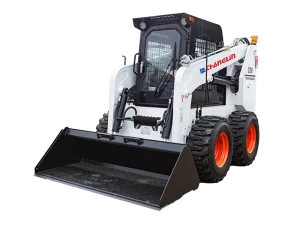
Machine Focus: Skid Steer Loaders (TS100, 275F), Compact Crawler Excavators (ZG150).
Engineering Requirements: Zero tail-swing design, high-flow auxiliary hydraulics (for cold planers, augers, and breakers), quiet cabs with ROPS/FOPS level-2 certification for urban compliance.
5. Global Enterprise Procurement Strategy: Total Cost of Ownership (TCO) Optimization
For enterprise procurement officers, the sticker price of construction equipment represents only 20-30% of lifetime machine expenditure. Evaluating Chinese earthmoving equipment manufacturers requires a comprehensive TCO model incorporating fuel burn efficiency, maintenance intervals, spare-parts logistics costs, and end-of-life residual value.
CAPEX vs. OPEX Analysis
By sourcing directly from certified Chinese factory platforms like Sinomach-HI, fleets reduce initial capital expenditure by up to 35%. This capital conservation allows contractors to increase unit redundancy on job sites or allocate capital toward advanced telematics and automated machine guidance upgrades.
- Lower Initial Investment: Faster project ROI realization.
- Standardized Parts Interoperability: Common filters and hydraulic seals cut inventory holding costs by 25%.
- Optimized Shipping Configurations: Compact skid steers and 15T excavators nested into 40ft HQ containers to minimize ocean freight tariffs.
International Shipping & Logistics Execution
Heavy machinery transport demands flexible shipping protocols based on machine footprint and port infrastructure.
- RoRo (Roll-on/Roll-off): Recommended for fully assembled motor graders, wheel loaders, and road rollers to ensure zero saltwater exposure during ocean transit.
- Flat Rack Containers: Ideal for 30T+ crawler excavators (ZG385, ZG480) with boom dismounting protocols.
- Break-Bulk Cargo: Utilized for multi-unit fleet shipments bound for major infrastructure project ports in Latin America, Southeast Asia, and Africa.
Excavation & Heavy Earthmoving Heavy Line
Heavy-duty crawler excavators and high-capacity wheel loaders built for high material throughput, digging force, and round-the-clock reliability.








6. Technical Procurement FAQ & Field Engineering Guide
Direct, expert-verified answers to high-intent questions asked by international fleet owners, plant managers, and equipment buyers sourcing from Chinese OEMs.
How do Chinese earthmoving machinery manufacturers ensure structural boom and frame durability under extreme loads?
Leading OEM factories utilize High-Strength Low-Alloy (HSLA) steel (such as Q355D, Q690D, or HARDOX wear plates) for critical structural weldments. Boom and arm sections undergo Finite Element Analysis (FEA) to eliminate stress concentration points. Weld seams are processed using fully automated robotic tandem welding systems and verified through non-destructive Ultrasonic Testing (UT) and Magnetic Particle Testing (MT) before primer coating.
What engine emission standards are available for export to regulated markets like North America and Europe?
Chinese factories manufacture equipment configurations compliant with global emission tiers. Machines destined for North America and Europe feature EPA Tier 4 Final / EU Stage V engines (utilizing Selective Catalytic Reduction, DPF, and DOC technologies) powered by Cummins or Deutz. For non-regulated or Tier 2/3 markets in South America, Africa, and Central Asia, simplified mechanically controlled engines (Weichai, Yuchai, Shanghai Diesel) are available to handle higher-sulfur fuels without fuel system damage.
What is the technical breakdown of operational savings between diesel and electric wheel loaders?
Electric wheel loaders utilize permanent magnet synchronous motors (PMSM) with direct energy conversion efficiency above 95%, compared to ~35-40% thermal efficiency for diesel engines. On average, a 5-ton electric loader consumes 30-45 kWh of electricity per operating hour under standard load, costing roughly $4-$6/hr depending on local industrial electricity rates. A comparable 5-ton diesel loader burns 14-18 liters of diesel per hour, costing $15-$22/hr. This creates a net operational saving of $10-$16 per operating hour, generating up to $40,000 in annual savings per unit under two-shift work schedules.
How is global aftermarket spare-parts availability managed by Chinese factories?
International product support is executed through a dual structure: centralized factory spare-parts hubs in Changzhou and a global network of over 300 authorized regional dealers and 650+ service centers. Factories supply digital spare-parts catalogs (EPC) indexed by VIN/serial numbers, allowing fast identification of replacement components. Critical fast-wearing items (filters, bucket teeth, hydraulic seals, track shoes) are stocked locally by distributors, while complete assembly components can be dispatched via air freight within 48 to 72 hours.
What hydraulic system configurations are deployed on medium to large excavators?
Modern Chinese excavators (such as the ZG210, ZG385, and ZG480) utilize negative-flow or positive-flow load-sensing hydraulic systems (LSS) supplied by Kawasaki or Rexroth. These systems feature variable displacement axial piston pumps paired with main control valves engineered for independent boom, arm, and swing priority control. This electro-hydraulic matching prevents hydraulic pressure drops during combined movements, delivering smoother operator control and a 10% reduction in hydraulic power loss.
Can factory-direct machines be customized for specific OEM color schemes or buyer attachments?
Yes. OEM factories offer complete Private Labeling / Original Design Manufacturing (ODM) services for volume fleet buyers and regional equipment distributors. Customizations include factory-applied custom paint finishes, dealer branding decals, auxiliary hydraulic piping options (single-acting for breakers, dual-acting for tilt-rotators and grapples), quick-coupler installation, and specialized cab comfort upgrades.