The Paradigm Shift in Global Heavy Equipment Procurement
How Chinese heavy machinery original equipment manufacturers (OEMs) have evolved from cost-effective alternatives to global technology leaders in hydraulic earthmoving machinery.
In the contemporary global construction and mining sectors, selecting a China heavy equipment excavator manufacturer is no longer merely a decision based on capital expenditure reduction. Over the past two decades, Chinese heavy machinery manufacturing has undergone a profound structural shift. By integrating state-of-the-art hydraulic control systems, heavy-duty structural steel casting, and intelligent telematics, leading Chinese OEMs now deliver heavy equipment fleets that rival traditional Western brands in operational longevity, hydraulic efficiency, and breakout force while offering a superior Total Cost of Ownership (TCO).
Global economic restructuring, accelerated infrastructure development across Africa, South America, Central Asia, and Southeast Asia, and the demand for rapid project execution have heightened the need for resilient heavy machinery supply chains. Leading Chinese manufacturers—supported by state-of-the-art automated manufacturing facilities in industrial hubs such as Changzhou, Jiangsu—have established centralized, vertically integrated production lines capable of manufacturing medium-to-large crawler excavators, motor graders, wheel loaders, and compaction machinery under strict ISO 9001, CE, and EAC quality regimes.
Information Gain Insight: Procurement analysis demonstrates that heavy excavators produced by top-tier Chinese OEMs yield an optimal operational cost ratio over a 10,000-hour machine lifespan. Savings stem not only from lower initial capital outlay, but also from component modularity, standardized maintenance interfaces, and worldwide spare parts availability.
Macro Heavy Machinery Solutions for Diverse Sectors
From high-volume opencast mining to municipal civil works, heavy excavators function as the foundational unit of multi-equipment machinery fleets.
Mining & Mass Excavation
Heavy-duty crawler excavators in the 36-ton to 50-ton class (e.g., ZG380, ZG480) designed for continuous rock overburden removal, quarry loading, and severe mining conditions.
- High-torque engines with low-RPM power curves
- Reinforced heavy-duty booms and box-section track frames
- Custom bucket options up to 2.5–3.2 m³ capacity
Highway & Infrastructure Fleets
Integrated equipment fleets combining medium excavators (ZG360), heavy motor graders (PY220H), and vibratory rollers (GYR162) for rapid road construction and earthmoving.
- Synchronized machine speed profiles for haul roads
- Precision hydraulic control for fine grade preparation
- Fuel-efficient dual-mode hydraulic pumps
Municipal & Environmental Engineering
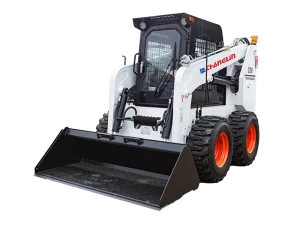
Specialized machinery including landfill compactors (GYL203/GYL233) and compact skid steer loaders (255F, TS100) engineered for waste management and tight urban sites.
- High-density cleated drum compaction for landfills
- Auxiliary hydraulics for multiple quick-change attachments
- Enclosed cab positive-pressure air filtration
Engineering Rigor & Hydraulic System Optimization
A look inside the mechanical, hydraulic, and structural design standards driving high-performance excavators.
The core capability of a heavy excavator relies on the harmonization of three primary engineering modules: the powertrain system, the main hydraulic distribution block, and the structural chassis kinematics. Top Chinese heavy equipment excavators utilize negative flow control or positive flow control (PFC) hydraulic architectures designed to minimize energy loss across control valves.
| Excavator Model | Operating Weight (kg) | Rated Power (kW/rpm) | Standard Bucket (m³) | Main Hydraulic Pump Type | Max Digging Force (kN) |
|---|---|---|---|---|---|
| ZG360 Crawler Excavator | 34,300 | 198 / 2000 | 1.6 | Variable Displacement Axial Piston | 235 |
| ZG380 Crawler Excavator | 37,600 | 212 / 2000 | 1.8 | Dual Kawasaki / Rexroth PFC System | 258 |
| ZG385 Crawler Excavator | 38,200 | 215 / 1900 | 1.9 | Electronically Controlled Main Pump | 265 |
| ZG480 Mining Excavator | 47,800 | 299 / 1800 | 2.4 - 2.8 | Heavy-Duty Mining-Spec Twin Pump | 320 |
Advanced Hydraulic Integration
Modern Chinese excavators incorporate high-pressure hydraulic components capable of operating continuously at 34.3 to 37.0 MPa system pressure. Flow-regeneration circuits on both boom down and arm in movements allow gravity-assisted fluid return, cutting cycle times by up to 8% and fuel usage by up to 12% during high-repetition loading operations.
Structural Finite Element Analysis (FEA)
Structural integrity is ensured through computer-modeled FEA simulation prior to physical casting. Booms feature internal baffle plates to absorb torsional forces, while heavy-duty track frames are robotically welded using high-tensile steel alloys, reducing stress concentrations across X-frame cross-sections.
Localized Application Scenarios & Extreme Environments
Heavy machinery must operate reliably in challenging geographic, climatic, and altitude conditions.
High Altitude Operations
Engineered for low air density environments above 4,000 meters altitude (such as the Andean Plateau or Central Asian mountain ranges). Turbocharger recalibration maintains air-to-fuel ratios without thermal overload.
Extreme Cold Climate
Configured for sub-zero operation in CIS regions down to -40°C. Equipped with fuel pre-heaters, cold-start glow systems, synthetic low-viscosity hydraulic oils, and arctic-grade rubber sealings.
High Heat & Arid Dust
Designed for Middle Eastern and North African job sites up to +50°C. Features oversized aluminum radiators, multi-stage cyclone air pre-cleaners, and dust-sealed cabin enclosures.
Coastal Marine & Saline
Built for port facility work and island reclamation. Structural steel receives multi-layer polyurethane anti-corrosion treatments and nickel-plated hydraulic cylinder rods to resist rust.
Worldwide Certification, Compliance & Support Networks
Protecting your capital investment through international regulatory alignment and predictable global logistics.
Emissions & Safety Compliance
Machines are engineered to comply with regional emission standards, offering engine configurations ranging from Tier 2 / Tier 3 for unregulated markets to Stage V and Tier 4 Final with DPF/DEF systems for North America and Europe. Cab structures comply with ROPS/FOPS safety standards (ISO 3471/3449).
Logistics & Delivery Logistics
Heavy excavators and machinery are shipped globally using optimized ocean transport: Roll-on/Roll-off (RoRo), Flat Rack, or Break-bulk shipping for large excavators (ZG380/ZG480), and containerized SKD/CKD methods for compact skid steers (TS100/255F) to minimize landed freight costs.
Lifecycle Spare Parts Delivery
Our global distribution network maintains centralized spare parts depots stocking structural components, hydraulic seal kits, control valves, track chains, and wear plates. Emergency spare parts shipments are dispatched via international air freight within 48 to 72 hours.
Technology Roadmap: Electrification & Autonomous Operation
Leading the transition toward zero-emission earthmoving and intelligent, telematics-connected jobsites.
The heavy equipment manufacturing industry is undergoing rapid technological development driven by decarbonization mandates and jobsite digital transformation. As a forward-thinking China heavy equipment excavator manufacturer, research and development plans focus on three primary innovations:
1. Electrification & Pure Electric Loaders/Excavators
Building on electric wheel loader designs (such as EV variants of the 5-ton and 8-ton loading series), battery-electric heavy excavators equipped with high-density LFP (Lithium Iron Phosphate) battery packs and 800V fast-charging architectures are entering field testing. These machines deliver zero local emissions, lower thermal output, and up to 60-70% reductions in energy operating costs.
2. 3D Autonomy & Telematics
Integrating 3D GPS/GNSS guidance systems directly into the excavator’s pilot hydraulic controls allows operators to achieve dig-to-grade accuracy within ±15mm. Integrated IoT telematics transmit real-time hydraulic pressures, oil temperatures, fuel consumption rates, and fault codes to centralized fleet management dashboards.
3. Electro-Hydraulic Main Valves
Replacing traditional mechanical pilot lines with fully electronic main control valves (e-MCV) enables customizable joystick sensitivities, automated anti-spill bucket movements, and seamless integration with third-party autonomous site control systems.
Frequently Asked Questions by Global Equipment Buyers
Answers to essential technical, logistics, and operational questions regarding heavy machinery procurement from China.