
Featured Heavy Machinery Portfolio (Part I)
Explore state-of-the-art heavy earthmoving and compaction machinery engineered directly by leading Chinese industrial manufacturers for overseas infrastructure projects, mining sites, and commercial contracting.







Executive Summary: The Macro Transformation of Chinese Heavy Equipment
The global landscape of industrial construction and earthmoving equipment has undergone a structural transformation over the past decade. Historically categorized as budget-friendly alternatives, leading China industrial machinery manufacturers have positioned themselves at the forefront of global heavy machinery engineering, smart manufacturing, and zero-emission electrification. Procurement directors, mining operators, and civil engineering conglomerates now evaluate Chinese OEMs not merely on initial capital expenditure (CapEx) savings, but on rigorous metrics of Total Cost of Ownership (TCO), hydraulic thermal efficiency, structural fatigue resistance, and telematics-driven fleet management.
With state-backed industrial clusters centered in key manufacturing hubs such as Jiangsu (Changzhou), Shandong, and Hunan, Chinese manufacturers operate fully integrated supply chains. By vertically synthesizing structural steel fabrication, high-precision CNC machining, electro-hydraulic valve integration, and real-time robotic testing, facilities produce heavy equipment designed to withstand extreme operational stresses—from sub-zero mining in CIS regions to high-altitude Andean quarries and extreme thermal environments across Africa and the Middle East.
China Factory 4.0: Supply Chain Resilience & Manufacturing Superiority
Modern Chinese heavy industrial facilities represent some of the most advanced "Lighthouse Factories" globally. Automated production lines utilize high-definition laser cutting, multi-axis robotic welding cells, and ultrasonic non-destructive weld testing to eliminate structural anomalies in heavy chassis, excavator booms, and grader moldboards.
Modular Chassis Platforms
Standardized chassis and structural architecture reduce engineering variance across 15 to 50-tonne excavators and wheel loaders. This modularity streamlines spare-parts logistics and speeds up custom engineering modifications for global buyers.
Tier-1 Component Integration
Chinese manufacturers strategic partner with top global component architects—integrating Tier 4 Final / EU Stage V engines (Cummins, Weichai, Perkins), electro-hydraulic main valves (Kawasaki, Rexroth), and heavy-duty transmissions (ZF, Hangchi).
Robotic Assembly & Quality Control
Fully automated coordinate measuring machines (CMM) ensure structural tolerances within 0.02 mm. Every machine undergoes dynamic pressure testing, roll-over protective structure (ROPS) verification, and 100% full-load hydraulic thermal equilibrium trials before port dispatch.
| Manufacturing Vector | Legacy Manufacturing Standard | Industry 4.0 Chinese OEM Standard | Impact on Enterprise Fleet Buyers |
|---|---|---|---|
| Structural Welding | Manual Shielded Metal Arc (SMAW) | Robotic Tandem MAG Welding & Ultrasonic Inspection | Elimination of internal fatigue cracks; +40% boom stress threshold. |
| Hydraulic Circuit Assembly | Dust-Controlled Cleanrooms | ISO 14444 Class 16/14/11 Automated Flush Cells | Prevents premature valve spool sticking; extends fluid life by 1,500 hours. |
| Powertrain Calibration | Static Bench Testing | Transient Dynamic Dynamometer + Telematics Profiling | Optimized fuel consumption curves (-8% to -14% fuel burn per ton moved). |
| Corrosion Protection | Standard Primer & Enamel Paint | Electro-Deposition Coating (ED) + Polyurethane Finish | Resists 1,500+ hours of salt-spray testing in harsh marine and mining sites. |
Next-Gen Technical Roadmap & Future Outlook (2026–2030)
The next decade of industrial machinery is defined by three converging technological waves: high-voltage electrification, autonomous site telematics, and eco-hydraulic flow matching. Chinese manufacturers are pioneering these transitions through aggressive R&D investments.
1. 800V Electrification & LFP Thermal Management
Lithium Iron Phosphate (LFP) battery chemistry, refined extensively in China's automotive supply chain, has transitioned directly into heavy machinery. Modern electric wheel loaders and compact excavators feature 800V high-voltage platforms capable of dual-gun fast charging (0 to 80% charge in 50 minutes). Integrated liquid cooling plates maintain optimal battery temperatures during continuous heavy-digging cycles, delivering energy cost reductions of up to 60-70% compared to equivalent diesel units.
2. Autonomous Site Telematics & CAN-Bus 5.0
Equipped with 3D GNSS satellite positioning, LiDAR obstacle detection, and electro-hydraulic proportional valves, Chinese motor graders and excavators achieve grade tolerances within ±10mm automatically. Fleet managers monitor real-time hydraulic pressure drops, engine load percentage, fuel burn, and operator behavior through centralized cloud telematics platforms with API access for enterprise ERP system integration.
Heavy Equipment Family Technical Analysis
Selecting the right machine architecture requires a granular understanding of hydraulic flow requirements, engine torque curves, and undercarriage options. Chinese industrial machinery covers six primary heavy-equipment categories engineered for specific duty cycles.
Crawler Excavators (14T – 50T+)
Utilizing positive flow hydraulic control systems, units like the 21-tonne ZG210, 33-tonne ZG330D, and 48-tonne ZG480 balance breakout force with swing acceleration. Heavy-duty x-frame undercarriages distribute ground pressure evenly, while reinforced boom structures prevent stress concentration in hard-rock quarrying.
Motor Graders (150HP – 320HP)
From the agile PY150 and PY180H to the massive PY320T mining grader, these machines feature gear-driven moldboards, hydraulic articulation joints, and no-spin differential axles. Designed for haul-road creation, bank sloping, and sub-base leveling with extreme blade-down pressure.
Compactors & Road Rollers
Heavy single-drum vibratory rollers (e.g., GYS142, GYS08J) and specialized landfill compactors incorporate dual-frequency, dual-amplitude hydraulic vibration units. High static linear loads guarantee optimal soil and asphalt compaction densities in fewer passes.
Bulldozers (160HP – 320HP)
Crawler dozers such as the YD160 employ hydraulic torque converters and power-shift transmissions. High-capacity semi-U blades, robust track chain assemblies, and single/triple shank rippers excel in land clearing and heavy overburden reclamation.
Skid Steer Loaders
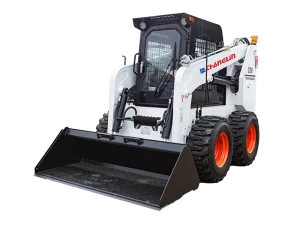
Compact wheel skid steers (e.g., TS100, 275F) utilize high-flow auxiliary hydraulic circuits (up to 120 L/min) to drive trenchers, cold planers, and hydraulic breakers. Ideal for urban construction, agricultural material handling, and confined space logistics.
Wheel Loaders (Diesel & Electric)
Offering 3 to 8-tonne payload capacities, these machines incorporate heavy-duty planetary transmissions and load-sensing steering. Electric variants eliminate local emissions entirely for underground tunneling and indoor industrial stockpiling.
Macro Industry Solutions & Application Field Scenarios
No two job sites present identical challenges. Equipment configuration must account for ambient temperatures, material density (t/m³), altitude derating factors, and fuel sulfur content.
1. Open-Pit Mining & Heavy Quarrying
Site Challenges: High abrasive rock impact, continuous 24/7 duty cycles, severe dust accumulation.
Engineered Solution: Heavy-duty excavators (ZG480) equipped with rock buckets, reinforced side-cutters, dual-stage air pre-cleaners, and heavy mining graders (PY320T) to maintain smooth haul roads, reducing haul truck tire wear by up to 25%.
2. Cross-Country Highway & Infrastructure Projects
Site Challenges: Long stretch projects requiring strict compaction densities and precise sub-base tolerances.
Engineered Solution: Paired deployment of PY180H/PY220H motor graders equipped with automatic 3D grading systems and GYS142 vibratory rollers, ensuring compliance with international road construction standards.
3. Landfill Management & Solid Waste Compaction
Site Challenges: Highly corrosive environments, bio-gas hazards, low traction materials.
Engineered Solution: Dedicated landfill compactors featuring cleated steel wheels with cleaner bars, protective underbody guards, and positive-pressure cabs fitted with activated carbon air filtration.
4. High-Altitude & Extreme Thermal Workzones
Site Challenges: Engine oxygen starvation above 3,000m altitude; hydraulic oil overheating in +50°C desert heat.
Engineered Solution: Custom turbocharger altitude matching, high-capacity aluminum radiators, independent hydraulic oil cooling circuits, and engine cold-start grid heaters for cold climates down to -40°C.
Global Enterprise Procurement & Total Cost of Ownership (TCO) Framework
Experienced B2B procurement managers evaluate equipment acquisitions through a comprehensive Total Cost of Ownership model. Buying directly from top-tier Chinese manufacturers yields optimized financial metrics across four key phases:
1. Initial Acquisition (CapEx)
Direct factory purchasing eliminates intermediary markup fees, saving 25-35% upfront compared to traditional Western brands. Flexible payment structuring including Irrevocable LC at sight, TT, and project-based machinery leasing supports cash flow management.
2. Operational Energy Burn (OpEx)
Advanced load-sensing hydraulics and electronically controlled fuel injection systems optimize power delivery. Fuel consumption drops by 10-15% per cubic meter moved, while electric powertrain options slash energy expenditure by over 60%.
3. Maintenance & Parts Logistics
Standardized component architecture ensures that routine replacement parts (filters, seal kits, ground-engaging tools) are available locally or shipped within 48-72 hours from regional parts hubs in key continents.
Localization Support, Compliance & Quality Assurance
International deployment of heavy machinery requires strict compliance with regional regulatory mandates and environmental laws. Leading Chinese exporters provide complete certification documentation and global service frameworks.
Global Regulatory Certifications
Machines exported to North America, Europe, and Australia carry official CE marking, EPA Tier 4 Final / EU Stage V emission certificates, and certified ROPS/FOPS operator cab safety documentation. For developing markets, robust Tier 2 / Tier 3 mechanical engine configurations remain available to match local fuel sulfur concentrations.
After-Sales Service & Technician Training
With a global presence spanning over 300 dealers and 650 authorized service centers, international buyers benefit from on-site commissioning, factory-trained technical support, interactive 3D parts manuals, and VR-assisted operator training modules.
Industry Whitepaper Technical Q&A (FAQ)
Featured Heavy Machinery Portfolio (Part II)
Explore additional high-performance compaction rollers, heavy dozers, motor graders, and crawler excavators manufactured to rigorous international industrial standards.






