
Heavy Machinery & Earthmoving Equipment Showcase
Direct factory equipment selections integrated with high-torque powertrains, heavy-duty rear rippers, and advanced load-sensing hydraulics.







Global Heavy Infrastructure & China's Manufacturing Industrial Shift
Understanding how Chinese motor grader OEM facilities have evolved into tier-1 global manufacturing engines powering international road and mining infrastructure.
The global construction machinery market has undergone a paradigm shift over the past two decades. In no sector is this more visible than in heavy earthmoving and precision road grading equipment. As megaprojects across Latin America, Southeast Asia, Sub-Saharan Africa, and the Middle East demand robust machinery capable of handling highly abrasive soils, dense hardpan, and rocky terrain, the reliance on high-performance motor graders equipped with rear rippers has accelerated exponentially.
Historically, tier-1 Western original equipment manufacturers (OEMs) dominated the motor grader market. However, high procurement capital expenditure (CAPEX), inflated replacement part costs, and extended component lead times created significant friction for international mining syndicates and engineering, procurement, and construction (EPC) contractors. Chinese heavy machinery manufacturers—anchored by specialized manufacturing complexes such as Sinomach-HI (Changlin)—have transformed from low-cost domestic suppliers into high-precision, vertically integrated global engineering leaders.
Structural Steel Integration
Chinese factories utilize ultra-high-strength Q345B and Q690D structural steel combined with robotic continuous submerged-arc welding to ensure frame rigidity under heavy torsional ripping loads.
Global Component Standardization
Strategic integration with Tier-1 global powertrains (Cummins, Weichai engines; ZF electro-hydraulic power-shift transmissions; Meritor heavy-duty wet axles) ensures localized spare parts availability globally.
Smart Hydraulics & Telematics
Modern load-sensing proportional hydraulic systems (LSSV) coupled with integrated 3D GNSS auto-blade positioning provide millimeter-accurate sub-base finishing while reducing fuel burn.
The strategic inclusion of a heavy-duty rear ripper assembly converts a standard road grader into a dual-purpose heavy earthmoving unit. Prior to final blade pass operations, compacted gravel, shale, old asphalt, or frozen sub-bases must be fractured. China motor grader manufacturers have perfected the engineering balance between frame weight distribution, rear axle downward pressure, and hydraulic breakout force, ensuring that rear ripper penetration does not lift drive tandem wheels off the ground—thus preserving maximum tractive effort.
Mechanical & Hydraulic Architecture of Ripper Motor Graders
An in-depth structural analysis of rear ripper linkage, hydraulic pressure distribution, and circle drive torque dynamics.
1. Rear Ripper Kinematic Linkage: Single-Shank vs. Multi-Shank Rippers
The structural efficiency of a motor grader ripper relies on kinematic linkage configuration. Chinese manufacturers offer two primary rear-mounted ripper topologies tailored to ground density:
- Parallel Linkage Rear Rippers: Maintains a constant tooth attack angle throughout the entire lifting and lowering stroke. This is ideal for continuous pavement scarification and asphalt fracturing where predictable depth penetration is required.
- Radial Linkage Rear Rippers: The ripper shank arc changes angle during penetration. This maximizes initial penetration pressure, allowing teeth to bite into dense, unyielding rock strata or permafrost.
| Specification Metric | Light-Duty Scarifier | 3-Shank Heavy Ripper | 5-Shank Heavy Ripper | Single Mining Rock Ripper |
|---|---|---|---|---|
| Maximum Penetration Depth (mm) | 250 - 300 mm | 450 - 520 mm | 400 - 480 mm | 600 - 800 mm |
| Ripping Width (mm) | 1,100 - 1,400 mm | 1,800 - 2,200 mm | 2,100 - 2,400 mm | 800 - 1,200 mm |
| Lift Above Ground (mm) | 350 mm | 480 - 550 mm | 480 - 550 mm | 600 - 700 mm |
| Shank Tooth Alloy Steel | Forged Boron Steel | Chromium-Molybdenum Alloy | Chromium-Molybdenum Alloy | Cast High-Nickel Matrix |
| Target Operating Material | Loose Gravel / Soil | Compacted Sub-base / Asphalt | Clay / Hardpan Soil | Severely Fractured Rock / Ore |
2. Powertrain & Hydraulic Flow Allocation during Ripping Operations
When a motor grader engages its rear ripper into hardpan, drawbar pull requirements spike exponentially. Chinese heavy-duty models (such as the PY220H and PY350T series) utilize variable-displacement axial piston hydraulic pumps paired with load-sensing proportional control valves (LSSV). This ensures that hydraulic pressure is prioritizing drive wheel traction and ripper shank downward thrust without bogging down engine speed.
Power transmission is managed via a heavy-duty electro-hydraulic power-shift transmission featuring a single-stage, three-element hydraulic torque converter. The rear tandem drive incorporates a No-Spin automatic anti-slip differential lock. When one side of the tandem drive encounters wet clay or loose aggregate while ripping, power is instantly transferred to the grounded wheels, preventing wheel spin and protecting tire sidewalls from abrasive wear.
Global Deployment Scenarios & Localized Applications
From high-altitude Andean mining haul roads to sub-Saharan desert road construction, Chinese ripper motor graders are optimized for extreme environments.
Open-Pit Mining Haul Roads
Heavy haul trucks carrying 100+ ton payloads quickly degrade pit haul roads, creating severe corrugated ruts. Mining-grade motor graders utilize 3-shank rear rippers to break hard rock outcroppings before leveling sub-bases with heavy-duty 14ft or 16ft moldboards.
Arid & Desert Road Development
Operating in ambient temperatures exceeding 50°C requires high-efficiency cooling packages. Heavy-duty aluminum radiator stacks with reversible hydraulic fans prevent oil thermal degradation while ripping sun-baked caliche and desert hardpan soils.
High-Altitude & Arctic Infrastructure
In permafrost zones (such as Central Asia or northern regions), rear rippers break frozen ground up to 600mm deep. Engines are pre-equipped with grid intake heaters and cold-weather hydraulic fluid bypass routes to permit low-temperature cold starts (-35°C).
Localized Configuration Matrix: Adapting Machinery to Regional Regimes
Sourcing heavy equipment requires careful alignment with regional operational standards, fuel quality, and operator safety mandates:
- Emissions Compatibility: Chinese factories configure engines according to target destination regulations—supplying Tier 2/Tier 3 mechanical injection engines for regions with high-sulfur fuel, or Tier 4 Final / EU Stage V engines with DEF/AdBlue systems for North American and European job sites.
- Cabin Safety & Ergonomics: Sealed, pressurized cabs fitted with integrated Roll-Over Protective Structure (ROPS) and Falling-Object Protective Structure (FOPS) according to ISO 3471 and ISO 3449 standards, preventing operator fatigue and ensuring site compliance.
- Wear Package Upgrades: Optional high-tungsten carbide wear strips for moldboard cutting edges and reinforced ripper shank boots engineered specifically for iron ore, bauxite, and granite excavation.
Total Cost of Ownership (TCO) & Sourcing ROI Analysis
A rigorous economic comparison of direct-from-factory procurement vs. traditional legacy equipment leasing and ownership models.
For fleet directors, municipal procurement committees, and mining concession holders, initial CAPEX is only one component of the equipment financial life cycle. True return on investment (ROI) is determined by fuel efficiency per cubic meter of ripped material, preventive maintenance costs, spare parts availability, and structural salvage value after 10,000 operational hours.
Direct Factory CAPEX Advantages
Procuring motor graders with factory-integrated rear rippers directly from major Chinese OEMs eliminates dealer markups and middleman commissions. Fleet owners achieve a 30% to 45% reduction in upfront capital expenditure without compromising engine output, transmission durability, or structural steel gauge.
OPEX & Fuel Efficiency Realities
Modern Chinese motor graders feature electronically controlled common-rail diesel engines optimized for flat torque curves at low RPMs. Combined with variable hydraulic displacement pumps, operational fuel burn is reduced by 12% to 18% during active rear ripping operations compared to legacy mechanical pump configurations.
Preventive Maintenance & Spare Parts Interchangeability
A critical advantage of top-tier Chinese manufacturers like Sinomach-HI is component standardization. By utilizing global standard interfaces across hydraulic hoses (PARKER/EATON), electrical connectors (DEUTSCH), and filter cartridges (DONALDSON), maintenance technicians can source consumables locally or rely on factory direct fast-track spare parts kits.
Factory Testing Protocols & International Quality Standards
How China's leading heavy equipment facilities execute quality assurance from raw plate cutting to pre-shipment functional validation.
Ultrasonic Weld Inspection
All load-bearing structural frames, draft bars, circle drives, and ripper mounting plates undergo 100% Non-Destructive Ultrasonic Testing (NDT) to verify weld penetration depth and eliminate internal structural voids.
Hydraulic High-Pressure Bench Testing
Hydraulic systems are pressurized to 125% of rated working capacity (up to 25 MPa) on factory test stands to test valve responses, cylinder seal integrity, and thermal heat dissipation under continuous load.
Full-Drive Track & Ripping Simulation
Before containerized packing or RoRo loading, every assembled motor grader undergoes a multi-hour dynamic obstacle track run. Ripper raise/lower functions, articulation joint angles, and braking systems are validated under operational stress.
Engineering Roadmap: Autonomous Grading & Electro-Hybrid Technology
The future of Chinese motor grader manufacturing focused on 3D automation, telematics diagnostics, and zero-emission drivetrains.
1. Integration of 3D GNSS & Automated Blade Control
Modern earthmoving operations demand sub-centimeter leveling accuracy. Leading Chinese factories pre-wire motor graders with plug-and-play electro-hydraulic interfaces compatible with international 3D grade control systems (Topcon, Trimble, Leica). Hydraulic proportional valves respond instantly to GPS/GNSS signal inputs, making real-time height adjustments to the moldboard while the operator focuses on vehicle steering and rear ripper depth control.
2. Telematics & Remote AI Fleet Diagnostics
IoT telematics terminals connected directly to the machine's CAN-bus transmit live engine parameters, hydraulic pressure spikes, transmission oil temperatures, and GPS tracking coordinates to cloud servers. Machine learning algorithms analyze operational data to alert fleet managers to preventive maintenance requirements (such as hydraulic filter clogging or ripper tooth wear) before catastrophic mechanical failure occurs.
3. Transition to Electric & Hybrid Powertrains
Leveraging China's world-leading battery technology ecosystem, motor grader factories are deploying pure electric and hybrid-electric prototypes. Electric-drive wheel loaders and motor graders eliminate engine idle fuel consumption, reduce noise levels in urban job sites to under 70 dB, and deliver immediate maximum torque to rear drive wheels—drastically improving rear ripper breakout performance in dense hardpan.
Complementary Heavy Equipment & Earthmoving Fleet
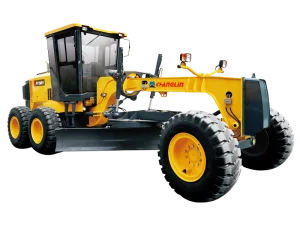
Explore our extended lineup of heavy road rollers, landfill compactors, mining excavators, and high-horsepower motor graders.




Frequently Asked Questions (FAQ) for Global Buyers
Technical, logistical, and commercial inquiries answered by experienced heavy equipment export specialists.