
Heavy-Duty Diesel Wheel Loaders for Iraq Operations
Engineered specifically for heavy earthmoving, oilfield site clearance, and aggregate quarrying under high thermal stress conditions in Southern and Central Iraq.


Buy Wheel Loader ZL50Z Manufacturers & Factory for Iraq Earthmoving Fleet
View Technical Specs & Pricing

China Wheel Loader ZL80H Manufacturers Factory for High-Capacity Iraq Ports & Mines
View Technical Specs & Pricing1. Macro Industry Dynamics & Iraq's Industrial Reconstruction Landscape
An in-depth analysis of heavy equipment demands driven by national master plans, oil sector infrastructure expansion, and highway logistics modernization.
The global heavy construction machinery market is undergoing a paradigm shift driven by technological hybridization, fuel efficiency optimization, and extreme-environment reliability engineering. In the Middle East—and specifically within the Republic of Iraq—this transformation intersects with an urgent national mandate for post-conflict reconstruction, massive infrastructure modernization, and energy sector expansion.
Following decades of infrastructure underinvestment, Iraq has embarked on multi-billion-dollar developmental initiatives. Major strategic programs—such as the Al-Faw Grand Port development, the Development Road Project (linking Basra to the Turkish border), extensive urban renewal in Baghdad and Mosul, and continuous maintenance of oilfield infrastructure in Rumaila, West Qurna, and Majnoon—require heavy machinery fleets capable of non-stop 24/7 duty cycles. Among these earthmoving platforms, the diesel wheel loader stands as the core mechanical workhorse.
Oil & Gas Infrastructure Support
Oilfield earthmoving, pipeline pad grading, and refinery aggregate handling in Basra, Zubair, and Missan demand heavy-duty 5-ton to 8-ton wheel loaders equipped with explosion-proof electrics and reinforced bucket lips to process abrasive desert terrain.
Aggressive Silica Sand Mitigation
Fine particulate dust in Anbar and Southern desert corridors inflicts rapid mechanical wear on standard engines. Factory-direct diesel loaders engineered for Iraq feature multi-stage oil-bath pre-cleaners and positive-pressure air filtration.
Variable Diesel Fuel Tolerance
Due to varying sulfur content and fuel supply chain fluctuations across Iraqi governorates, loader diesel engines must feature mechanical or high-pressure common rail (HPCR) injection systems with integrated water-separator technology.
In the Iraqi market, upfront machine acquisition cost accounts for only 22-25% of total lifetime operational expense. Fleet operators prioritizing direct OEM factory support, thermal cooling reserves, and spare parts interchangeability achieve a 38% reduction in un-programmed downtime during peak summer months (May to September).
2. Technical Engineering Matrix: Diesel Loader Factory Adaptations
Standard Chinese or European loader configurations often experience thermal de-rating or hydraulic seal deterioration when deployed in the Mesopotamian basin without desert-package modifications.
| Engineering System | Standard Global Factory Spec | Iraq Optimized Factory Spec (Sinomach-HI) | Operational Impact in Iraq Site Conditions |
|---|---|---|---|
| Engine Cooling Package | Standard single-plane radiator grid (Up to 40°C) | Enlarged multi-wing tropical radiator & independent hydraulic cooling (55°C) | Eliminates engine derating and coolant boil-over in Basra summer heat waves. |
| Air Intake Filtration | Dual-element dry paper filter | Oil-bath pre-cleaner + Turbo centrifugal dust ejector + HEPA cab filter | Protects cylinder liners from silica scouring; extends oil filter replacement intervals by 2.5x. |
| Hydraulic System & Seals | Standard NBR (Nitrile) seals & Mineral Oil | High-temp Fluororubber (FKM) seals & anti-wear ISO VG 68 tropical oil | Prevents fluid degradation, cylinder leakage, and hydraulic pressure drop under high load. |
| Bucket Structural Design | Standard Q345B steel with bolt-on lip | Reinforced high-strength steel (NM400/HARDOX) with rock-deflector teeth | Extends bucket operational lifespan when loading blasted granite or heavy alluvial clay. |
| Powertrain & Axles | Standard countershaft powershift transmission | Heavy-duty planetary powershift + reinforced bevel gear hub reduction axles | Delivers maximum rimpull torque for breakout force in dense clay and aggregate piles. |
Structural Stress Analysis & Machine Architecture
Earthmoving in Iraq's central alluvial plains involves high clay cohesion, placing extreme torsional stress on the loader's front and rear articulated chassis. Factory manufacturing standards utilize robot-welded box-section frames with wide-hinge articulation pins. Dual tapered roller bearings at the articulation pivot absorb both radial and axial loads, providing frame rigidity when operating on uneven quarry surfaces or unpaved logistics routes.
3. Sector-Specific Application Scenarios across Iraqi Governorates
Matching machine payload class, hydraulic configuration, and ground engagement tools (GET) to regional economic activities.
Northern Kurdistan: Stone Quarries & Rock Crusher Feeding
Primary Deployment: 6-Ton to 8-Ton Diesel Loaders (ZL60H / ZL80H).
In the mountainous topography of Erbil, Sulaymaniyah, and Dohuk, loaders operate inside limestone and marble quarries. Heavy payload capacities combined with rock buckets enable efficient stockpile loading directly into primary jaw crushers and tri-axle dump trucks.
Central Iraq: Urban Reconstruction & Municipal Works
Primary Deployment: 3-Ton to 5-Ton Diesel Loaders (ZL30H / ZL50Z).
In Baghdad, Hilla, and Karbala, compact footprint loaders handle concrete rubble removal, roadbed sub-base spreading, and utility trench backfilling. High maneuverability and fast cycle times allow contractors to navigate congested urban corridors.
Southern Ports & Oil Concessions: Bulk Cargo & Wellhead Prep
Primary Deployment: High-Dump & Coal/Bulk Bucket Loaders (ZL50Z / ZL80H).
Umm Qasr Port terminals and oilfields near Safwan require specialized attachments. High-lift loader arms feed grain hoppers and sulfur stockpiles, while heavy-duty counterweights stabilize machines during off-road transport of pipe skids.
4. Technology Roadmap & Factory Manufacturing Innovations
Next-generation engineering developments bridging heavy diesel reliability with smart telematics and hybrid efficiency.
Intelligent Telematics & Geofencing
Modern diesel loaders deployed to remote Iraqi job sites are equipped with IoT CAN-bus telematics modules. Fleet managers in Baghdad can monitor real-time fuel consumption, engine oil temperature, hydraulic pressure spike data, and satellite geofencing alerts, mitigating machine theft and preventing catastrophic component failure.
Electro-Hydraulic Load Sensing (LSS)
Transitioning from pure mechanical hydraulic levers to pilot-operated electro-hydraulic joysticks reduces operator fatigue during 12-hour shifts. Variable-displacement axial piston pumps supply hydraulic flow strictly on demand, cutting fuel consumption by 12% to 15% per ton of material moved.
Modular Component Interchangeability
Factory manufacturing protocols emphasize cross-platform component standardization. Engines, transmission assemblies, control valves, and hydraulic cylinders are designed with shared mounting points across excavator and grader lines, simplifying spare-parts inventory management for Iraqi dealers and large fleets.
Require Custom Diesel Loader Specifications for Iraq Tenders?
Our OEM engineering team provides direct export support, technical bid compliance documentation, custom desert cooling packages, and Umm Qasr port CIF logistics support.
Send Inquiry Now5. Complete Earthmoving & Infrastructure Machinery Ecosystem
Maximize site efficiency by pairing Sinomach-HI diesel wheel loaders with matched excavators, motor graders, road rollers, and skid steers for balanced fleet productivity across Iraq.

Buy Road Roller GYS08J Manufacturer & Factory for Iraq Highway Projects
View Technical Specs & Pricing
China Skid Steer Loader TS100 Manufacturer for Iraq Urban Reconstruction
View Technical Specs & Pricing


China High Performance 22T Excavator ZG220 Factory for Iraq Utility Works
View Technical Specs & Pricing
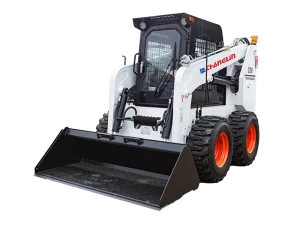
China Skid Steer Loader 275F Manufacturer for Iraq Maintenance Operations
View Technical Specs & Pricing
Buy Crawler Excavator ZG380 Factory for Heavy Iraq Earthworks & Quarries
View Technical Specs & Pricing6. Frequently Asked Questions: Diesel Loader Procurement in Iraq
Expert technical advice addressing logistics, shipping terms, fuel system compatibility, customs documentation, and after-sales warranty support for Iraqi buyers.
How do Sinomach-HI diesel loaders handle the high sulfur content found in some Iraqi diesel fuels?
Our factory installs multi-stage fuel filtration systems specifically engineered for Middle Eastern fuel grades. This includes a primary centrifugal water-separator with heating elements, followed by dual high-efficiency 2-micron secondary fuel filters. This configuration prevents fuel injector clogging, protects the high-pressure fuel pump, and preserves horsepower performance even when using higher sulfur diesel.
What shipping options and sea freight routes are available for heavy machinery delivery to Iraq?
Heavy construction equipment is typically shipped via RoRo (Roll-on/Roll-off) vessels or Flat-Rack containers directly from Chinese ports (Shanghai/Tianjin) to Umm Qasr Port, Iraq. Alternatively, shipments can be routed through Mersin Port (Turkey) or Aqaba Port (Jordan) for overland transit to Northern and Western Iraqi provinces under CIP or CIF terms.
How are spare parts and aftermarket servicing managed across Iraqi job sites?
Sinomach-HI maintains direct partnerships with localized service hubs and regional dealers across Baghdad, Erbil, and Basra. We offer fast-track air freight for critical components and supply recommended 2,000-hour operational spare parts packages (filters, wear plates, hydraulic seals, injectors) alongside machine shipments.
What factory warranty is provided for diesel wheel loaders operating under extreme desert heat?
All heavy-duty diesel loaders supplied to Iraq carry a standard 12-month or 2,000-operating-hour factory warranty (whichever occurs first), covering major powertrain components including engine, transmission, drive axles, and hydraulic pumps. Extended warranty packages up to 36 months are available upon request for major oil & gas contractor tenders.
Can machine cabs be configured with high-performance air conditioning for ambient temperatures over 50°C?
Yes. Every diesel loader exported to the Middle East comes standard with a reinforced HVAC climate control cab system producing up to 6,000 kcal/h of cooling capacity. Cab enclosures feature UV-reflective double-curved safety glass, positive pressure sealing to exclude ambient dust, and ergonomic suspension seats for operator comfort.