
High-Performance Earthmoving Machinery for Nigerian Projects
Engineered for extreme ambient temperatures, heavy laterite subgrades, and rigorous infrastructure duty cycles across West Africa.




Nigeria’s Infrastructure Boom & The Strategic Demand for Motor Graders
An exhaustive analysis of federal highway expansion, regional mining development, and heavy equipment procurement parameters across West Africa's largest economy.
Macro Infrastructure Growth Drivers in Nigeria
The Federal Republic of Nigeria is experiencing an unprecedented surge in civil infrastructure investment, driven by ambitious federal and state initiative frameworks. Projects such as the landmark 700km Lagos-Calabar Coastal Highway, the ongoing expansion of the Trans-Sahara Highway network, the Ajaokuta-Kaduna-Kano (AKK) gas pipeline feeder road network, and the revitalization of agricultural haulage corridors under the Presidential Infrastructure Development Fund (PIDF) have reshaped the heavy machinery ecosystem. Earthmoving contractors, state ministries of works, and international engineering procurement construction (EPC) conglomerates are actively scaling up fleets to meet stringent project deadlines.
Within this expanding construction ecosystem, the motor grader occupies a critical position. Unlike standard excavators or wheel loaders primarily designed for material displacement and loading, motor graders provide the millimeter-level leveling precision, bank sloping, ditch cutting, and sub-base surface compaction required before asphalt laying. In Nigerian soil conditions—dominated by highly variable laterite, clay mixtures, and expansive black cotton soils—achieving precise road crowns and structural drainage ditches is mandatory to prevent premature pavement degradation caused by torrential seasonal rains.
Tropicalized Engineering for Tropical African Terrain
Standard heavy machinery configured for temperate European or North American climates frequently encounters catastrophic thermal degradation, hydraulic fluid breakdown, and premature engine wear when subjected to Nigeria's ambient environment. Operational realities include ambient temperatures exceeding 45°C in Northern states such as Kano, Maiduguri, and Sokoto during dry seasons, combined with extreme airborne silica dust concentrations during the Harmattan period.
Leading motor grader manufacturers servicing the Nigerian market must engineer units with heavy-duty tropical cooling packages, high-efficiency multi-stage air filtration with centrifugal pre-cleaners, anti-corrosive radiator matrix coatings, and direct-drive variable-speed hydraulic fans. Furthermore, fuel delivery systems must be recalibrated with multi-stage water-separating fuel filters to tolerate varying regional diesel quality and high sulfur content, ensuring continuous operating uptime without injector fouling or fuel pump seizure.
Technical Architecture: Motor Grader Design for Heavy Subgrades
Evaluating powertrain dynamics, moldboard geometry, tandem axle load distribution, and hydraulic control systems.
Powertrain & Torque Reserve
High-tier heavy motor graders engineered for Nigeria utilize heavy-duty turbocharged diesel engines (such as Cummins or Weichai powertrains) featuring optimized power curves. High low-end torque output allows operators to slice through compacted laterite layers without engine lugging or hydraulic stall. Hydro-mechanical power-shift transmissions with single-lever control deliver 6 forward and 3 reverse speeds, matching ground velocity precisely to soil density.
Moldboard & Circle Drive
The core of precision grading lies in the moldboard assembly. Advanced units feature heat-treated, high-carbon steel cutting edges with optimized involute blade curves that promote rolling action rather than dragging material. A heavy-duty internal-tooth circle drive motor equipped with hydraulic overload protection prevents gear shearing when hitting subterranean granite deposits common in the Jos Plateau and Oyo State quarries.
Hydraulics & Load Sensing
Proportional Priority Pressure-Compensated (PPPC) load-sensing hydraulic valves ensure identical flow rates to both sides of the blade regardless of load variations. Operators can manipulate blade lift, circle tilt, frame articulation, and ripper penetration simultaneously without hydraulic lag, maximizing hourly productivity across complex slope grading assignments.
Empowering Nigerian Construction Infrastructure with Proven Reliability
Integrating global manufacturing standards with deep localized field support across West Africa.
Global Manufacturing Excellence
Leading Chinese earthmoving machinery manufacturers have invested heavily in automated robotic welding lines, structural finite element analysis (FEA), and high-precision CNC gear manufacturing. Motor graders produced in world-class Changzhou and Jiangsu manufacturing hubs meet ISO 9001 quality management benchmarks and undergo 100% factory pre-delivery load testing. This ensures that every unit dispatched to West Africa possesses structural integrity equal to or exceeding traditional Western OEMs at a significantly superior Total Cost of Ownership (TCO) advantage.
Localized OEM Partnerships in Nigeria
Commercial success in Nigeria requires far more than exporting machinery; it demands robust local presence. Preferred manufacturers establish strategically placed regional spare parts hubs in Lagos (Ikeja/Lekki), Abuja (Idu Industrial Layout), Port Harcourt, and Kano. By stocking critical wear parts—such as cutting edge blades, hydraulic hoses, filter kits, tandem drive chains, and wear strips—contractors minimize machine downtime and maintain project timelines.
Specific Localized Application Scenarios Across Nigerian States
Tailored machine configurations designed for regional geological conditions and industrial projects.
1. Highway Subgrade & Base-Course Construction
Operational Zones: Lagos-Ibadan Expressway, Abuja-Kano Dual Carriageway, East-West Road (Delta-Rivers-Akwa Ibom).
Technical Requirement: Preparing uniform laterite subgrades and stone-base aggregate spreading before asphalt application. Motor graders configured with heavy rear rippers break dense hardpan laterite, while front push blocks assist haul trucks. Frame articulation enables offset crab steering, allowing the rear tandem wheels to remain on firm ground while the blade dresses soft ditch banks.
2. Mining & Quarry Haul Road Maintenance
Operational Zones: Solid mineral mines in Kogi, Nasarawa, & Plateau States; Granite Quarries in Ogun & Oyo States.
Technical Requirement: Mining motor graders (190hp to 240hp class) operate continuously to smooth haul roads carrying 50+ ton rigid dump trucks. Regular leveling removes fallen rock fragments, prevents tire sidewall cuts on haulers, reduces rolling resistance, and lowers overall mine fuel consumption. Heavy duty moldboard side shift systems withstand intense impact loads.
3. Agricultural Land Preparation & Feeder Roads
Operational Zones: Agricultural Belts in Benue, Kaduna, Niger, Taraba, and Jigawa States.
Technical Requirement: Opening up rural access roads to connect remote farm clusters with urban distribution markets. Motor graders cut V-shaped drainage ditches to direct tropical rainfall away from unpaved roads during monsoon months, preventing washout, muddy rutting, and isolation of agricultural communities.
4. Urban Drainage & Reclamation Projects
Operational Zones: Lekki Free Zone reclamation, Port Harcourt urban renewal, Enugu township expansions.
Technical Requirement: Precise slope grading inside tight urban corridors. Modern compact and medium-frame motor graders featuring tight turning radiuses, 3D GPS blade control readiness, and low-emission engines allow civil engineering firms to execute fine grading around underground utility structures and concrete drainage channels.
SONCAP Certification, Regulatory Compliance & Import Logistics
Navigating customs clearance, Standards Organisation of Nigeria mandates, and maritime shipping procedures.
SONCAP & NIS Regulatory Adherence
Importing heavy construction equipment into Nigeria requires strict compliance with the Standards Organisation of Nigeria Conformity Assessment Program (SONCAP). Prior to factory shipment from China, equipment manufacturers must obtain a Product Certificate (PC) and SONCAP Certificate (SC). These certificates verify that the motor grader structural frames, braking systems, noise emissions, operator cabs (ROPS/FOPS compliance), and electrical safety circuits conform to Nigerian Industrial Standards (NIS).
Partnering directly with established motor grader manufacturers ensures all factory documentation, chassis VIN stamping, CE declarations, and pre-shipment inspection reports (Clean Report of Inspection / Certificate of Inspection) are fully compliant, eliminating costly customs holding delays at Nigerian ports.
Maritime Shipping & Port Clearance Logistics
Heavy motor graders are typically dispatched from major Chinese ports (Shanghai, Ningbo, Qingdao) directly to Nigerian maritime entry points, primarily Lekki Deep Sea Port, Tin Can Island Port / Apapa Port (Lagos), and Onne Port (Port Harcourt).
Depending on unit dimensions and client preference, machinery is shipped via:
- Roll-on/Roll-off (RoRo) Vessels: Direct drive-on/drive-off loading, offering maximum protection from sea-spray corrosion.
- Flat Rack Containers: Ideal for specialized transport, securing heavy framed machinery with heavy-duty lashing points.
- Break-Bulk Cargo: Utilized for large multi-unit fleet orders under municipal or federal tender contracts.
The Future of Motor Grader Technology in West Africa
Smart telematics, 3D GNSS blade automation, and low-emission powertrain evolution.
Smart Telematics & Fleet IoT
Modern motor graders exported to Nigeria come integrated with 4G/GPS satellite telematics modules. Remote fleet managers in Lagos or Abuja can monitor real-time fuel consumption, engine thermal levels, hydraulic pressure metrics, operator hours, and precise GPS location via centralized cloud dashboards, preventing unauthorized machine usage and optimizing routine maintenance schedules.
3D Automated Grade Control
Integration with Trimble, Leica, or Topcon 3D grade control systems allows motor grader moldboards to adjust elevation and slope automatically based on digital CAD road models. This technology eliminates the need for manual stake setting on Nigerian highway projects, accelerating grading speeds by up to 40% while reducing fuel consumption and material over-spending.
Fuel-Efficient & Hybrid Drives
As fuel costs represent a major portion of operational expenses in West Africa, next-generation motor grader designs feature electro-hydraulic fan drives, variable displacement piston pumps, and eco-mode engine management maps. These innovations reduce hourly diesel burn by 12% to 18% without compromising moldboard blade pull capability.
Frequently Asked Questions: Motor Graders in Nigeria
Expert answers to technical, operational, and procurement queries for Nigerian contractors and equipment buyers.
Explore Our Full Range of Heavy Equipment for West Africa
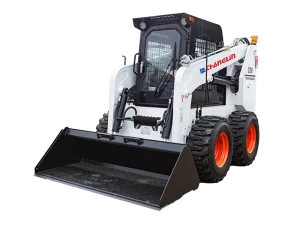
Single-source machinery manufacturing: excavators, loaders, dozers, rollers, and skid steers configured for extreme job site conditions.






Ready to Upgrade Your Machinery Fleet in Nigeria?
Connect with our senior engineering specialists to receive custom technical configurations, factory-direct FOB/CIF pricing, SONCAP compliance support, and comprehensive spare parts supply plans.